
 Performances + Events
NEC Prep Ensembles
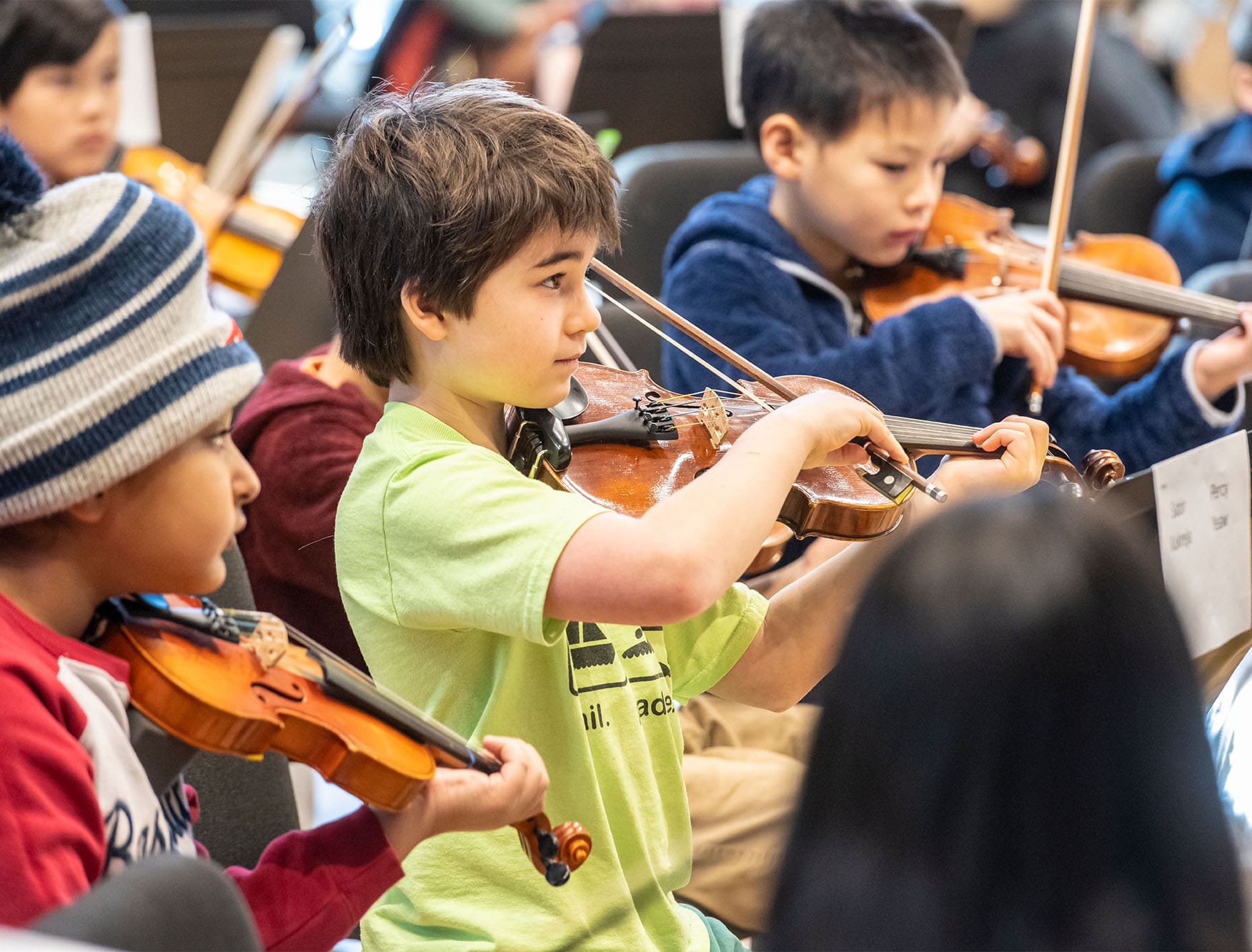
Ensembles provide a performance-based learning experience across jazz, orchestral, wind, and contemporary genres.
In this environment, aspiring musicians expand their musical curiosity and realize their full expressive potential.
Chamber Music Intensive Performance Seminar (CHIPS)
For students with a strong interest in chamber music, NEC Prep is excited to offer the Chamber Music Intensive Performance Seminar (CHIPS). CHIPS offers advanced students an in-depth chamber music immersion experience, with an emphasis on enhancing chamber music skills and performance practice at a high artistic level. Led by faculty members Laura Blustein and Soovin Kim, accepted students will be placed into a string quartet or piano trio and assigned repertoire to study over the year. The CHIPS program is open to violinists, violists, cellists, and pianists.
Significant emphasis will be placed on performance; groups will have the opportunity to perform in recitals at NEC and in the community, as well as potential international performance opportunities. This year’s student-artists performed in masterclasses led by renowned musicians such as Donald Weilerstein and Miriam Fried. Past guest artists include the Verona Quartet, Paul Biss, Roger Tapping, Peter Salaff, Paul Katz, Areta Zhulla, and Kim Kashkashian. Given the intensity of this program, attendance at all CHIPS events is required.
Interested violinists, violists, cellists, and pianists between the ages of 13 and 18 years old are encouraged to apply.
NEC Prep’s Chamber Music Intensive Performance Seminar is generously supported by The Robert and Jane Morse Endowed Chamber Music Fund at NEC.
Chamber Music
The NEC Prep Chamber Music program offers intermediate to advanced students in strings, piano, woodwinds, and brass opportunities to perform in small ensembles one-on-a-part.
Students have the opportunity to:
- Receive personal attention from faculty in a nurturing small group setting
- Learn practice and rehearsal techniques
- Develop sensitivity in listening while playing
- Share musical opinions and ways to interpret their scores
- Develop more confidence in performing with others
- Mature into deeper levels of musicianship while being motivated by their peers
Each ensemble is coached by a highly experienced teacher and performer who has a passion for chamber music and loves to work with young musicians. Groups receive one hour of coaching weekly on Saturdays during the academic year and participate in end-of-semester workshops and concerts during the Winter and Spring Chamber Music Festivals. Select student groups may also have the opportunity to play in a Chamber Music Showcase in Jordan Hall and perform in and attend special masterclasses given by distinguished faculty artists.
Application and Registration
All students interested in chamber music placement need to apply every year. The age for placement is 8-18 with the minimum age of 8 years old by September 1. Once formed, ensembles are expected to stay together for the full academic year.
Registration and tuition fee payment are required before placement. Groups are matched by ability, instrumentation, age, and scheduling availability. In the event placement is not possible, a full tuition refund will be given.
Preformed groups are welcome to apply. All members of the group must list each other’s names and instruments on the chamber music placement scheduling form and offer the same available hours for coaching times as one another.
Select advanced wind players whose teachers highly recommend their chamber music placement with strings and piano may also apply for mixed ensemble placement by following the instructions for string and piano ensemble placement below.
To find out more about chamber ensemble placement for winds, brass, saxophone, harp, guitar or Baroque instruments, please visit the department pages for these instruments or contact the individual department chairs.
Prerequisites
- Students should have ongoing private teacher’s support for the entire academic year during which they are studying chamber music. Please note that as part of the application process, a recommendation from your private teacher will be required.
- Good rhythmic skills – ability to count and keep a steady pulse, facility with subdivisions of note values such as 8th notes, triplets, 16th notes and dotted rhythms.
- Good music reading skills – consistent ability to read, hear, and play notes and rests accurately, facility with articulations, dynamics, and phrasing.
Suggested Skills
We welcome your application even if you are still developing some of these skills.
Violin and Viola: Comfort and facility with 3rd and 5th positions or higher, familiarity with articulations and bow strokes including legato, détaché, and staccato. Ability to coordinate shifts and string crossings rhythmically. Additionally for violists: facility with treble and alto clef reading.
Cello: Facility in shifting up to 4th position or above, ease with tenor clef reading, familiarity with articulations and bow strokes including legato, détaché, and staccato. Ability to coordinate shifts and string crossings rhythmically.
Piano: Facility with parallel scales and arpeggios in 3-4 octaves. Rhythmical fluency and coordination of moderate or fast accompaniment figurations in the left hand with lyrical lines in the right. Familiarity with bringing out contrapuntal lines in Baroque music as exhibited by works such as Bach Inventions and Little Preludes.
Advanced string students are encouraged to audition with movements from a major concerto accompanied by a movement from the Bach Solo Suites, Partitas and Sonatas, or other works which show technical prowess and lyrical abilities.
Advanced pianists are welcomed to audition and demonstrate their technical facility and lyricism through works like, but not limited to, major concertos, Bach Prelude and Fugues, Beethoven Sonatas, Chopin Etudes, Rachmaninoff Preludes, and other virtuoso character pieces.
Application Requirements for String and Piano Chamber Music
- NEC Prep Chamber Music Application
- Teacher’s Recommendation Form
- Placement Scheduling Form
- Audition Videos (requirements below)
- Two contrasting solo works
- One fast work demonstrating technical facility
- One work showing lyrical playing
- Two scales
- Two contrasting solo works
Mid-March
NEC Prep application opens.
May 15
Chamber Music applicants can wait until the August 1 deadline to submit everything OR submit application materials including registration fee and audition videos at the same time as their orchestra audition material. Placement scheduling form will be sent to families in July and will be expected by August 1.
July 1
Chamber Music Placement Forms will be sent out to all NEC Prep chamber applicants who have already applied before that date. Anyone applying after July 1 will receive the form automatically as part of their application.
August 1
- Chamber Music Application and Registration Fee due
- Teacher’s recommendation Form due
- All videos or updated videos due
- Placement Scheduling Form due
Early September
Scheduling and Placement results will be shared with all families
- Dr. Carol Ou – NEC Prep Chamber Music Chair
- Aimee Tsuchiya – NEC Prep Chamber Music Assistant Chair
- Alexei Doohovskoy – Brass Chair and Interim Woodwind Chair
- Ken Radnofsky – Saxophone Faculty
- Franziska Huhn – Harp Faculty
- William Riley – Guitar Faculty
- Aldo Abreu – Early Music Co-Chair
- Renée Hemsing – Early Music Co-Chairs
Orchestras
Juliano Aniceto, Director
Rehearsals: Saturdays, 3:15-6 p.m.
Praising “the highly talented teenagers who fill the ranks of the YPO,” and their “expressively charged and technically accomplished performances,” Boston Globe music critic Jeremy Eichler has written: “One of the special pleasures of hearing a youth orchestra comes from knowing that many of its members have been encountering the music, even a cornerstone of the repertory like the Brahms Fourth Symphony, for the very first time. As a result, the playing can sometimes brim with the visceral thrill of discovery.”
The orchestra collaborates with renowned soloists, presenting a great mix of traditional and new repertoire, allowing students to engage in different styles and genres, combining a set of attractive and audacious programming that enhances the experience of students and audiences.
Admission to this extraordinary ensemble is extremely selective. The outstanding students in the Youth Philharmonic Orchestra generally play at a level that will gain them admission to selective conservatories. The ensemble is open by audition to highly advanced pre-college strings, winds, brass, percussion and harp players. While orchestral assignments are made by level and not age, most members of the ensemble are in grades 10 through 12.
The orchestra’s 16 international concert tours have enriched audiences on four continents and established YPO as one of the finest youth orchestras in the world.
Steven Karidoyanes, Director
Rehearsals: Saturdays, 3:15-6 p.m.
The talented students who are placed in the Youth Symphony generally play with a high level of musicality and technical mastery, are comfortable playing complete concertos from all stylistic periods, and have significant prior orchestral and chamber music experience. The ensemble is open by audition to highly advanced pre-college strings, winds, brass, percussion and harp players. While orchestral assignments are made by level and not age, most members of the Youth Symphony are in grades 10 through 12.
As one of NEC’s senior Prep School ensembles, YS has performed in NEC’s Jordan Hall, Symphony Hall, and Sanders Theatre. YS has also performed at the Boston Opera House in collaboration with the Boston Ballet School.
Peter Jarvis, Director
Rehearsals: Saturdays, 10 a.m.-12 p.m.
Students placed in the String Chamber Orchestra, which is open by audition to advanced players, generally perform with a high level of musicality and technical mastery and are comfortable playing complete concertos. Repertoire is chosen from the wealth of glorious serenades and character pieces written for string orchestra, such as the Tchaikovsky String Serenade and the Holberg Suite by Edvard Grieg.
Members develop advanced ensemble skills and a group confidence performing in various venues on campus, including Jordan Hall, the Plimpton Shattuck Black Box Theatre, and the Green Cafe. Most students enjoy playing in the chamber orchestra along with their participation in full orchestras, such as the Youth Philharmonic Orchestra, Youth Symphony, Youth Repertory Orchestra, Junior Repertory Orchestra, and the String Repertory Orchestra.
Seating in SCO is on a rotating basis in order to offer a more complete experience for every member in the group. While orchestra assignments are made by level and not age, most members of the String Chamber Orchestra are in grades 9 through 12
Cynthia Woods, Director
Rehearsals: Saturday, 1-3:00 p.m.
Students placed in the Youth Repertory Orchestra, which is open by audition to advanced string, woodwind, brass, and percussion players, generally perform with good intonation and tone quality using a variety of bow strokes and dynamics, and are comfortable playing complete concertos from the Baroque and Classical periods. While orchestral assignments are made by level and not age, most members of Youth Repertory Orchestra are in grades 8 through 12.
Adam Grossman, Director
Rehearsals: Saturday, 1-2:30 p.m.
Students placed in the Junior Repertory Orchestra, which is open by audition to upper-intermediate-level strings, woodwinds, brass and percussion players, generally perform with fluidity, have a developed vibrato, and are comfortable playing three-octave scales and arpeggios. While orchestral assignments are made by level and not age, most members of the Junior Repertory Orchestra are in grades 7 through 10.
Cynthia Woods, Director
Rehearsals: Saturdays, 10:30 a.m.-12 p.m.
Students placed in the String Repertory Orchestra, which is open by audition to intermediate string players, perform with fluency and clarity and are comfortable playing three-octave scales. While orchestral assignments are made by level and not age, most members of the String Repertory Orchestra are in grades 7 through 10.
Marta Zurad, Director
Rehearsals: Saturdays, 8:30-10 a.m. and 10:30 a.m.-12 p.m.
Students placed in the Preparatory String Orchestra, which is open by audition to early intermediate string players, are comfortable with such techniques as shifting and with fast passagework. While orchestral assignments are made by level and not age, most members of Preparatory String Orchestra are in grades 6 through 9.
Peter Jarvis, Director
Rehearsals: Saturdays, 8-9 a.m.
String Training Orchestra 8 a.m. Orchestra (STO 8) is open by audition to advanced-beginner string students. Students placed in this orchestra have mastered basic technical aspects of playing the instrument, can read music proficiently, are comfortable in some upper positions, and have often had previous ensemble experience. While orchestral assignments are made by level, not age, most members of STO 8 are in grades 4-7.
Peter Jarvis, Director
Rehearsals: Saturdays, 9-10 a.m.
String Training Orchestra is open by audition to advanced beginner string players. Students placed in this orchestra have mastered basic technical aspects of playing the instrument, can read music, and may have some previous ensemble experience. While orchestral assignments are made by level, not age, most members of STO 9 are in grades 3-6.
Wind Ensembles
Michael Mucci, Director
Allison Lacasse, Assistant Director
Rehearsals: Fridays, 4:15-6:15 p.m. (before Thanksgiving), 4:30-7 p.m. (after Thanksgiving)
The Senior Massachusetts Youth Wind Ensemble is open by audition to advanced high school students in grades 10-12 in the areas of woodwinds, brass, percussion, harp, double bass, and piano. Auditions are generally at the level of All-State auditions.
Alfred Dentino, Director
Allison Lacasse, Assistant Director
Rehearsals: Fridays, 4:15-6:15 p.m. (before Thanksgiving), 4:30-7 p.m. (after Thanksgiving)
Started in 2015, MYWE Concert Band is open by audition high school aged students. The music chosen for this ensemble represents a balance of traditional and contemporary concert band repertoire that will meet the needs of students who aspire to advance their musical skills to a level at which they can achieve their goals.
Jared Cassedy, Director
Allison Lacasse, Assistant Director
Rehearsals: Fridays, 4:15-6:15 p.m. (before Thanksgiving), 4:30-7 p.m. (after Thanksgiving)
The Junior Massachusetts Youth Wind Ensemble at NEC Prep is open to middle school and junior high school students in grades 6-9, in woodwinds, brass, percussion, harp, double bass, and piano. Auditions are generally at the level of Junior District Auditions.
Eli Epstein, Director
Rehearsals: Saturdays, 9:30-11 a.m.
Learn ensemble playing from former Cleveland Orchestra horn player and acclaimed pedagogue Eli Epstein! With his upbeat, positive approach to music-making, Epstein provides experiences that promote high levels of musicianship, enhance brass-playing technique, develop listening skills, encourage emotional expression, and address interpersonal and performance issues. This fun, energizing ensemble experience is open by audition to high school and middle school brass players.
Jazz
Robert Nieske, Director
Rehearsals: Saturdays, 3-5 p.m.
The Youth Jazz Orchestra (YJO) debuted in 2008 at NEC Prep. Since then, the YJO has been recognized as one of the Prep School’s premier large ensembles. YJO was featured as part of Boston’s First Night Celebrations for First Night 2010-12, and was showcased at the 2009 and 2010 Feasts of Music.
YJO performs twice a year in NEC’s Brown Hall. The orchestra is directed by celebrated jazz artist Bob Nieske, who is also a member of the NEC College faculty. YJO is open to pre-college-age trumpet, trombone, saxophone, piano, guitar, bass, and percussion students.
The NEC Prep Small Jazz Ensemble program is one of the largest programs of its kind in the nation. It is open to students aged 8 and up with any level of experience.
Each ensemble consists of a coach and three to five students; in rare instances, an ensemble may have two students. The coach functions as a band member, bandleader, and arranger, so students are playing with a professional musician for each rehearsal and performance. Each ensemble has a drummer, a bassist, a chordal instrument (piano and/or guitar), and various melodic instruments (winds, brass, voice, strings, pitched percussion). These ensembles are meant to expose students to performing a wide variety of pieces in jazz and related music styles. Students are encouraged to suggest pieces and to compose and arrange for these ensembles if they are interested.
Early Music Large Ensembles
Renée Hemsing, Director
Rehearsals: Saturdays, 8-10 a.m.
The BCO is a large ensemble for advanced string, wind, brass, and keyboard students who seek an unconventional orchestral experience and the chance to zoom in on the mercurial, fantastical, and riveting era that gave birth to Vivaldi’s Four Seasons, Bach’s Brandenburg Concerti, and Handel’s Messiah: the Baroque. Guided by principles of Historically Informed Performance (HIP), BCO musicians rehearse and perform virtuoso music exclusively from the Baroque period (1600-1750) including concerti grossi, orchestral dance suites, and secular and sacred works by the Baroque masters. This ensemble functions as a true Baroque chamber orchestra, led from the violin and/or harpsichord in accordance with its mission to promote exposure to historically accurate approaches. Rehearsals incorporate the study of musically relevant aspects of Baroque history and culture including:
- commonly practiced dance forms of the time.
- the art of rhetoric and its influence on performance.
- the importance of text in interpretation.
- access to recordings by HIP practitioners.
BCO musicians may access historical instruments and/or equipment from NEC whenever possible and necessary: Baroque bows, recorders, harpsichords, organ, etc. Throughout the course, renowned HIP experts visit the BCO to offer guest leadership and master classes, and BCO musicians may periodically audition to perform Baroque concerti with the orchestra in one of two concerts given per year.
Aldo Abreu, Director
Rehearsals: Fridays, 6:30-8:30 p.m.
The FBE is a unique and unconventional large ensemble opportunity for vibrant, spirited, and highly curious intermediate string, wind, brass, and keyboard students to delve into the music and performance practices of the Baroque (1685-1750). Guided by principles of Historically Informed Performance (HIP), the FBE emphasizes the foundations of ensemble playing through the lens of a musician in the Baroque era. That means in addition to rehearsing their repertoire, FBE rehearsals include the study of:
- Baroque orchestral music that includes wind parts
- Advanced ensemble skill development
- Phrasing based on performance practice.
Students may either be graduates of the PBE and/or Gabrieli/Corelli Ensembles, or may directly audition for placement into the FBE.
Early Music Small Ensembles
Renée Hemsing, Director
Rehearsals: Saturday, 10–11 a.m.
Named after beloved Baroque composer and teacher Antonio Vivaldi (1678-1741), who famously composed dozens of his greatest works for his students at the Ospedale della Pietà, the Vivaldi Ensemble is a small Baroque chamber ensemble for intermediate to advanced string, wind, keyboard, and vocal students seeking to expand on their ensemble skills in a small ensemble setting. The Vivaldi Ensemble receives one hour of weekly coaching on early repertoire (written before ~1750) with a Historically Informed Performance (HIP) approach. In this small ensemble, students:
- Receive personal attention from faculty in a nurturing small ensemble setting.
- Learn Baroque performance practice and rehearsal techniques.
- Develop sensitivity in listening while playing.
- Share musical opinions and ways to interpret early music scores.
- Develop more confidence in performing with others in two concerts per year.
Vivaldi students may be graduates of the FBE and/or may concurrently play in the BCO.
Aldo Abreu, Director
This group is open to all intermediate instrumentalists: strings, winds, brass, and percussion, including ethnic instruments such as the Guzheng. Medieval Ensemble players study & perform fast and complex dances called Istampie or Istampita, originating from the 12th -14th centuries, in addition to improving their improvisation skills. This ensemble performs in two Baroque concerts each year.
Aldo Abreu, Director
Rehearsals: Saturday, 1-2 p.m.
This small, registration-based ensemble invites intermediate and advanced students (ages 8+, minimum 2 years on instrument) to explore the full recorder family. Students do not need to own a recorder — participants may borrow fine instruments from NEC’s Harry Pratt Recorder Collection. The ensemble combines recorder instruction with ensemble rehearsal, giving students the technical training to play sopranino, soprano, alto, tenor, bass, great bass, and contrabass recorders.
Open to both recorder players and wind/brass students, this program is designed to complement your primary ensemble experience while deepening your musicianship. We encourage students to consider this ensemble as a way to broaden their skills, discover new sounds, and engage with a distinctive tradition of music-making.
Aldo Abreu, Director
Rehearsals: Saturday, 11 a.m. – 12 p.m.
Named after Baroque composer Giovanni Gabrieli (1554-1612), one of the earliest to write music specifically for winds, brass, and strings, the Gabrieli Ensemble is a small Baroque chamber ensemble for beginning to intermediate wind and brass students (between the levels of PBE and FBE) who seek to build large ensemble experience through the lens of a musician apprentice in the Baroque era. The Gabrieli Ensemble receives one hour of weekly coaching on canzoni and other early repertoire with a Historically Informed Performance (HIP) approach. In this small ensemble, Gabrieli students
- Receive personal attention from faculty in a nurturing small ensemble setting.
- Learn Baroque performance practice and rehearsal techniques.
- Develop sensitivity in listening while playing.
- Share musical opinions and ways to interpret early music scores.
- Develop more confidence in performing with others in two concerts per year.
- This ensemble encourages instruments that did not exist in early times such as the saxophone and clarinets to participate – parts will be custom made for their instruments.
Gabrieli students may be graduates of the PBE and, after one or more years of Gabrieli Ensemble, may qualify for placement in the FBE.
Renée Hemsing, Director
Rehearsals: Saturday, 11 a.m. – 12 p.m.
Named after Baroque composer and teacher Arcangelo Corelli (1653-1713), one of the earliest known string pedagogues, the Corelli Ensemble is a small Baroque chamber ensemble for beginning to intermediate string and keyboard students (between the levels of PBE and FBE) who seek to build ensemble experience through the lens of a musician apprentice in the Baroque era. The Corelli Ensemble receives one hour of weekly coaching on early repertoire (written before ~1750) with a Historically Informed Performance (HIP) approach. In this small ensemble, Corelli students:
- Receive personal attention from faculty in a nurturing small ensemble setting.
- Learn Baroque performance practice and rehearsal techniques
- Develop sensitivity in listening while playing
- Share musical opinions and ways to interpret early music scores
- Develop more confidence in performing with others in two concerts per year
Corelli students may be graduates of the PBE and, after one or more years of Corelli Ensemble, may qualify for placement in the FBE.
Renée Hemsing, Director
Rehearsals: Saturday, 2–3 p.m.
The PBE is a unique and unconventional ensemble opportunity for vibrant, spirited, and highly curious beginning string and keyboard students to be introduced to the music and performance practices of the early Baroque and Renaissance (mainly the 16th & 17th centuries). Guided by principles of Historically Informed Performance (HIP), the PBE teaches the foundations of ensemble playing through the lens of a musician apprentice in the Baroque or Renaissance. That means in addition to practicing the repertoire, PBE rehearsals include:
- Learning commonly practiced court dances of the time — and actually dancing them!
- Listening to recordings by experts playing on ancient instruments.
- Reading music from ancient musical scores of chant, early chorales, viol consorts, and more.
Aldo Abreu, Director
Rehearsals: Saturday, 2–3 p.m.
The PBE is a unique and unconventional ensemble opportunity for vibrant, spirited, and highly curious beginning wind and brass students to be introduced to the music and performance practices of the early Baroque and Renaissance (mainly the 16th & 17th centuries). Guided by principles of Historically Informed Performance (HIP), the PBE teaches the foundations of ensemble playing through the lens of a musician apprentice in the Baroque or Renaissance. That means in addition to practicing the repertoire, PBE rehearsals include:
- Learning commonly practiced court dances of the time — and actually dancing them!
- Listening to recordings by experts playing on ancient instruments.
- Reading music from ancient musical scores of chant, early chorales, viol consorts, and more.
- PBWE rehearses at the same time as PBE in a different room, leaving the opportunity open to collaborate together with PBE for some pieces.
Chorus
Rehearsals: Saturdays, 2–3:15 p.m.
Beginning in Fall 2026, the BSO × NEC Honors Children’s Choir brings together advanced treble singers ages 8–13 from across Greater Boston for a high-level choral experience through NEC’s Preparatory School. As part of the BSO × NEC Alliance, this tuition-free ensemble offers rigorous musical training alongside unique performance opportunities with the Boston Symphony Orchestra.
Designed for students already engaged in vocal or choral study, the ensemble deepens each singer’s primary training through focused ensemble work, independent preparation, and collaborative performance. Participation is intended to complement (not replace) a student’s existing musical commitments. Students must remain actively involved in another vocal or choral program, whether through a school, community organization, church choir, or private instruction.
Throughout the academic year, singers engage in a rigorous rehearsal process and perform in high-profile settings, including collaborations with the Boston Symphony Orchestra.
The BSO × NEC Honors Children’s Choir offers a distinctive pathway for young singers to refine their musicianship, engage with a broad community of peers, and experience the artistic demands and rewards of performing at a professional level.
Rehearsals: Saturdays, 3:15–5 p.m.
The NEC Youth Chorale is a highly celebrated mixed chorus for advanced singers in grades 9-12. This ensemble performs in NEC’s Jordan Hall and other regional venues. In recent years the choir has shared the stage with the NEC Youth Philharmonic Orchestra and NEC Youth Symphony, as well as the Cambridge Symphony Orchestra.
Composed of students from the greater Boston area and beyond, Youth Chorale offers singers the opportunity to experience and perform masterworks and octavo selections of the choral repertoire at an exceptionally high level. Recent concert programs have featured works such as Brahms’ Liebeslieder Waltzes, Haydn’s Missa in Augustiis (Lord Nelson Mass), Mozart’s Missa Brevis in F, K.192, and Bernstein’s Chichester Psalms.
Rehearsals: Saturdays, 1–2 p.m.
The Chamber Chorus is an ensemble open to singers in Grades 4-6 by placement audition. Rehearsal instruction in the Chamber Chorus emphasizes healthy vocal techniques for developing voices, musicianship, and ear-training through solfege and Takadimi rhythm syllables, as well as notation and score-reading skills. Students typically sing advanced unison, 2-part, and 3-part repertoire in a variety of styles and languages and perform at least two concerts per year.
Rehearsals: Saturdays, 11–11:50 a.m.
The Children’s Choir is open to singers ages 6-13 by placement audition. Rehearsal instruction in Children’s Chorus emphasizes healthy vocal technique for developing voices, musicianship, notation, and score-reading skills. Students typically sing unison and two-part repertoire in a variety of styles and languages, and perform two concerts per year.
Rehearsals: Saturdays, 10–10:50 a.m.
For Pre-K to Grade 1 (ages 4-6), if your child loves to sing, then Little Penguins Prep Chorus is the perfect opportunity for your child to experience the joys of singing with others in a choral setting. This class emphasizes healthy vocal technique for developing voices, early musicianship, and ear-training through solfege and Gordon rhythm syllables, as well as beginning notation, score-reading skills, and playing simple rhythm instruments. Students typically sing unison repertoire in a variety of styles and languages, with an emphasis on folk songs from around the world. Little Penguins Preparatory Chorus will be invited to perform in two vocal ensemble concerts in NEC’s Jordan Hall. No placement audition required.
How to Join NEC Prep
Whether your family is joining our community for the first time or your young musician is continuing their journey, our How to Join page is the starting point for students of all ages and levels to find their place at NEC Prep.
LEARN MORE ABOUT:
- Enrollment Types: Understand placement vs. registration-based enrollment.
- How to Enroll: A step-by-step roadmap for joining a class, ensemble, or private lessons.
- Audition Details: What to expect from the audition process for placement-based programs
- Frequently Asked Questions: Practical information for new and returning families.