
 Performances + Events
Undergraduate Programs
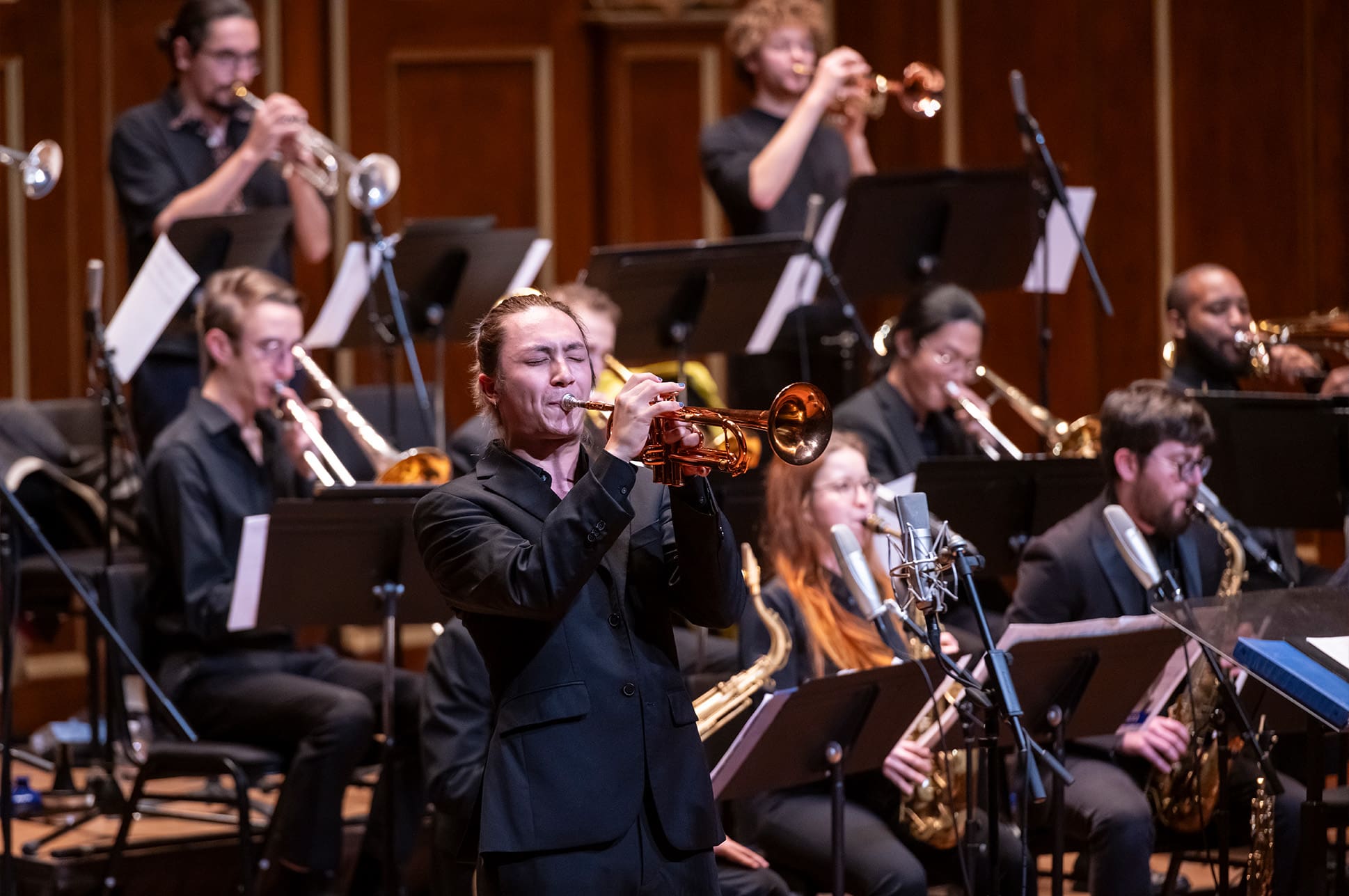
Pursuing a Bachelor of Music degree at NEC means immersing yourself in the thriving artistic atmosphere of the richest educational experience in music, anywhere — all against the inspiring backdrop of Boston.
The undergraduate experience at NEC is founded on intensive musical study with exceptional performing artists and faculty. Outside of the studio, students receive a broad education in the liberal arts through NEC’s one-of-a-kind integrative curriculum, electives, and access to coursework at other world-class Boston schools — all to prepare students to pursue rewarding careers and make an impact in their communities.
For more detailed information about graduate programs, please visit our academic catalog.
Bachelor of Music
The undergraduate curriculum provides extensive training in students’ majors, comprehensive instruction in music theory and music history, and an introduction to liberal arts disciplines. NEC offers the following majors:
- Bassoon
- Cello
- Clarinet
- Composition
- Contemporary Musical Arts
- Double Bass
- Euphonium
- Flute
- French Horn
- Guitar
- Harp
- Jazz Studies – Concentration in Composition
- Jazz Studies – Concentration in Performance
- Music History
- Music Theory
- Oboe
- Percussion
- Piano
- Saxophone
- Trombone
- Trumpet
- Tuba
- Viola
- Violin
- Vocal Performance
In addition to degree programs, undergraduates may also pursue a minor in Liberal Arts or Music Theory, or a concentration in Music Technology or Teaching Artistry and Music Education.
5-Year Bachelor/Master’s Programs
NEC’s 5-Year Bachelor/Master’s Programs programs enable students to combine exceptional musical training at NEC with the academic program of their choice at one of our partner institutions — Harvard College or College of the Holy Cross. Through these programs, students can earn both a Bachelor’s degree at a partner institution and a Master of Music degree at New England Conservatory over a five-year period.
Musicians enrolled in these programs have the flexibility to grow as artists and scholars, benefiting from the extraordinary faculty and resources of both campuses. Specialized advising ensures that dual-degree students can thrive throughout their educational journey.
These programs require separate applications and admission to both institutions. Please submit your applications by the required deadlines and indicate your interest in the dual-degree program on each application.
HOW IT WORKS
Earn a Bachelor of Arts or Bachelor of Science degree from Harvard College and a Master of Music from New England Conservatory.
The NEC + Harvard Dual-Degree Program is one of the most competitive dual-degree programs in the world, with only five to six students enrolling each year. Due to curriculum constraints, only first-year students at Harvard may apply to transfer into the dual-degree program.
- Years 1–3: Combine academic coursework at Harvard and studio instruction at NEC.
- Year 4: Complete bachelor’s degree at Harvard and begin fulfillment of Master of Music requirements at NEC.
- Year 5: Complete Master of Music degree at NEC.
Earn a Bachelor of Arts from College of the Holy Cross and a Master of Music from NEC. Applications will open for Fall 2027.
- Year 1: Begin academic coursework at Holy Cross.
- Years 2-3: Begin studio instruction at NEC and continue academic coursework at Holy Cross.
- Year 4: Complete Bachelor of Arts degree at Holy Cross and begin fulfillment of Master of Music requirements at NEC.
- Year 5: Complete Master of Music degree at NEC.
Piano + Collaborative Piano Dual-Degree Program
This unique and individualized curriculum is designed for talented pianists who seek the opportunity to explore both a solo and collaborative piano experience in a focused 5-year program, at the end of which students earn a Bachelor of Music in Piano and a Master of Music in Collaborative Piano.
During the first three years, students fulfill the normal requirements of the undergraduate piano major curriculum. In year two, required and free elective classes in fulfillment of the BM degree will also satisfy partial curricular requirements of the MM in Collaborative Piano degree. In year three, students receive bi-weekly lessons in collaborative piano in addition to their weekly solo piano lessons. This third year private collaborative instruction provides the necessary foundation in the instrumental-piano and vocal-piano repertoire, and prepares students for graduate level study beginning in their fourth year.
Piano majors will perform their annual piano promotionals in each of the first three years to confirm required progress in solo piano studies. A collaborative piano promotional is required at the end of the third year, which simultaneously confirms the student’s readiness for the Master of Music in Collaborative Piano. As the curriculum in the fifth year is focused entirely on collaborative piano studies, students will present their solo piano recital in the first semester of the fourth year and their collaborative piano recital at the end of their fifth year. Upon completion of the five years of study, students receive both a Bachelor of Music in Piano and a Master of Music in Collaborative Piano.
- At the time of applying to NEC, first-year applicants should prepare the normal piano major audition and on your application indicate their interest in the 5-year program.
- With your application, please include a video recording stating why you are interested in the program.
- All applicants must first be accepted by the Department of Piano in order to be eligible to audition for this dual degree program.
- Incoming first-year undergraduate piano majors interested in the program must alert their academic advisor during Orientation Week to carefully consider their classes in the first year.
Currently enrolled first- and second-year piano majors already at NEC may be considered for this program. Consult with your academic advisor early in the fall semester, confirm your eligibility, and schedule an audition time with the Collaborative Piano Department no later than the second semester of your second year.
For further questions about the program, please contact Collaborative Piano faculty, Pei-Shan Lee at pei-shan.lee@necmusic.edu.
Undergraduate Minors
The Liberal Arts minor provides NEC undergraduates the opportunity to gain breadth and depth of knowledge and understanding in a focused area of study in the Liberal Arts and Modern Languages, as well as a useful credential for pursuing further study and careers beyond NEC.
Liberal Arts minors are offered in the following areas:
- Literature
- Cultural Studies, including Philosophy, Religion, and Modern Languages (French, German, Italian)
- History and Social Studies
- Creative Arts
- Science and Mathematics
Alternatively, students may design a personalized curriculum with a selected sequence of courses that coherently combines more than one area of study, such as Cultural Studies and History.
The Music Theory minor prepares students for further in-depth theoretical study and work, such as graduate placement exams, a major or double major at the graduate level, and teaching assistant positions in graduate schools.
Music Theory minors are offered in the following tracks:
- Performance and Analysis
- Studies in Contemporary Music
- Music Theory and Applied Composition
- Research in Music Theory
Undergraduate Concentrations
The Early Music Concentration is a practical and curricular course of study rooted in performance and scholarship. The Early Music Concentration provides students the opportunity to intensely pursue studies in historically-informed performance on both period and modern instruments through private lessons taught by musicians actively performing in early music ensembles, participation in small and large ensemble work, seminars and masterclasses, and coursework that supports and amplifies the student’s vocal and instrumental progress. Capstone projects will include performance and production opportunities, as well as fellowships and internships.
The Improvisation Concentration provides students outside of CMA and Jazz majors the opportunity to focus a portion of their electives on skill-building in such areas as improvisation, global music traditions, jazz, interdisciplinary performance, and/or songwriting/composition. Open to students of all experience levels, this concentration provides a flexible course of study tailored to individual interests and goals. Students will work with their advisor and CMA Chair to select the courses and ensembles that best support their needs.
The Music Technology Concentration, designed by the student in conjunction with a faculty advisor, enables focused study in such areas as performance with electronics and multimedia, scoring for new media, synthesis, real-time processing, spatialization, recording/mixing, technology-based analysis, and algorithmic music. Students who complete this concentration will demonstrate a high level of competence with specific music technologies and an awareness of current creative and technical work in the field.
The Teaching Artistry and Music Education Concentration is a curricular course of study rooted in real-world teaching experience and community partnership. In alignment with the broader teaching artist field, the concentration uses a menu-based approach, allowing students to customize the concentration to focus on their intended style(s) of teaching and community-engaged musicmaking in spaces such as K-12 classrooms, private lesson studios, creative aging, El Sistema programs, concert hall stages, collegiate music instruction, social change projects, and more.
Undergraduate Diploma
This program consists of three years of full-time study in instrumental performance, vocal performance, or composition. Students register for studio, repertoire coaching, ensemble, chamber music, and coursework related to their major. Audition standards are higher than those for the Bachelor of Music program.
Undergraduate Performance Certificate
The one-year certificate program affords students the opportunity of crafting a customized, focused curriculum that centers around studio instruction instrument/area of study, supplemented by elective offerings that complement the studio experience and align with the student’s professional, artistic and/ or academic objectives. This program is designed at the undergraduate level, so requires a high school diploma or equivalent.
In addition, applicants must meet or exceed the undergraduate minimum for TOEFL or its equivalent. Students are required to present a final project, the nature and scope of which will be determined between the student and studio instructor. A performance is not required, but students who choose this as their final project may opt for a half-recital. The final project will be evaluated by the studio instructor and—if appropriate—by other faculty members, as determined by the department chair. Studio instruction is required of all undergraduate certificate students; in addition, all orchestral instrumentalists are required to register for a large ensemble each semester.