
 Performances + Events
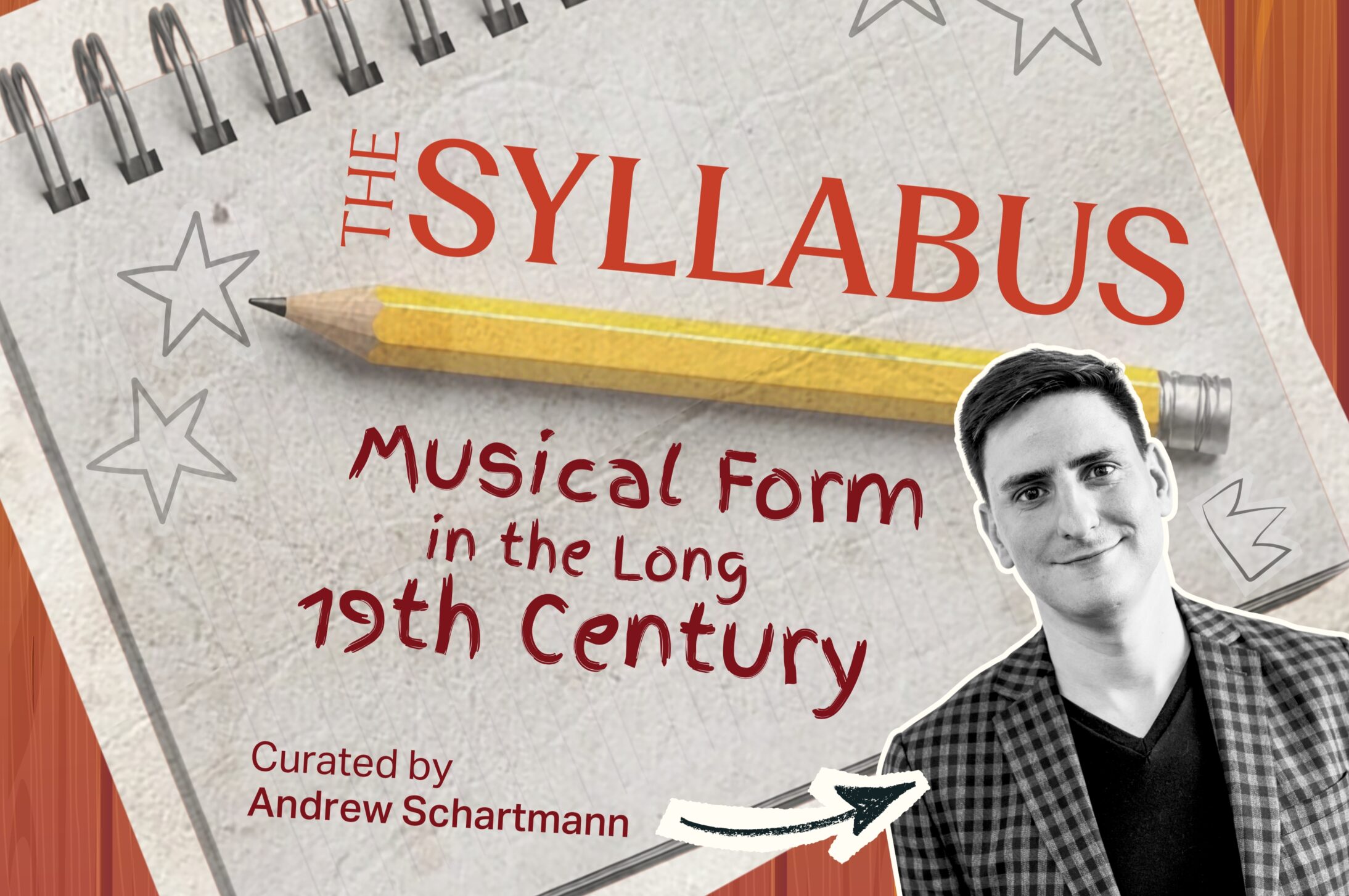
In addition to honing their artistic practice in studios, rehearsal rooms, and concert halls, students at NEC take classes that contextualize and examine the music they’re learning and performing. Our latest Apple Music playlist, The Syllabus, explores faculty member Andrew Schartmann’s Music Theory Department course Musical Form in the Long Nineteenth Century through works by iconic composers.
“Contemporary theories of musical form are based largely on 18th-century music,” Schartmann explained. “So what happens when we apply them to the decades that follow? This course explores that question across the long 19th century, from the French Revolution to World War I, asking whether this repertoire demands new analytical approaches, or whether older ones can be extended to engage music that never fully leaves its past behind.”
Here is the playlist Schartmann curated, with an explanation about how each selection relates to the course material.
Andrew Schartmann’s Selections
1. C.P.E. Bach: “Prussian” Sonata in F major, H. 24, Mvt. III — Miklós Spányi
The “binary sonata,” a defining feature of galant style, became an unlikely but persistent presence in 19th-century music. This movement by C.P.E. Bach provides a clear model against which to hear how this inherited form was reworked and extended by later composers.
2. Ludwig van Beethoven: Symphony No. 8, Mvt. I — Orchestre Révolutionnaire et Romantique conducted by John Eliot Gardiner
At first listen, this movement can feel like a return to an earlier style. But Beethoven engages classical conventions with striking self-awareness, continually setting up and subverting expectations. The result is a subtle but inventive renewal of inherited formal ideas.
3. Franz Schubert: Winterreise, Op. 89, D. 911, No. 14, “Der greise Kopf” — Matthias Goerne and Alfred Brendel
Schubert’s songs often draw on familiar small forms of the classical era, but his text settings reshape those conventions at a fundamental level. In “Der greise Kopf,” formal boundaries become expressive moments, shaped as much by textual meaning as by musical design.
4. Robert Schumann: Kinderszenen, Op. 15, No. 13, “Der Dichter spricht” — Martha Argerich
Schumann’s miniatures often draw on familiar binary and ternary designs, but their poetic framing recasts how those forms unfold. In “Der Dichter spricht,” Schumann infuses the music with a reflective, narrative quality that subtly bends inherited structures in unexpected ways.
5. Franz Liszt: Symphonic Poem No. 5, Prometheus — London Philharmonic Orchestra conducted by Bernard Haitink
Liszt’s symphonic poems draw on inherited models such as the overture and sonata form, but recombine them into a single, continuous span. In Prometheus, large-scale structure unfolds through ongoing transformation, challenging the assumption that form proceeds through clearly articulated divisions.
6. Frédéric Chopin: Ballade No. 1 in G minor, Op. 23 — Arthur Rubinstein
This large-scale, single-movement design engages multiple formal models without fully settling into any one of them, unfolding instead with a sense of narrative continuity that shapes its overall design.
7. Clara Schumann: Piano Trio in G minor, Op. 17, Mvt. I — Boulanger Trio
This movement engages sonata form at a moment when its conventions were being actively codified. In Schumann’s hands, large-scale boundaries between sections are strikingly clear, even as the internal space within them becomes more expansive and flexible.
8. Richard Wagner: Overture to Der fliegende Holländer — The Norwegian National Opera Orchestra conducted by Edward Gardner
A potpourri of leitmotivic ideas organized along a sonata-like trajectory, this overture shows how 19th-century composers rethink form when themes carry explicit dramatic meaning. Here Wagner blurs the line between formal design and narrative function.
9. Gustav Mahler: Symphony No. 6, Mvt. I — New York Philharmonic conducted by Leonard Bernstein
In the late 19th century, sonata principles are stretched across an expansive temporal and expressive field. In this movement, Mahler pushes the form to its limits, so that it is recognized less through clear sectional divisions than through large-scale processes like return, rotation, and transformation.
10. Claude Debussy: “Nuages,” from Nocturnes — Berlin Philharmonic conducted by Claudio Abbado
Form emerges through patterns of recurrence and rotation rather than traditional tonal direction. In “Nuages,” Debussy organizes musical time through subtle returns and transformations rather than clear cadential goals.
Listen to The Syllabus
As the first conservatory to become an Apple Music Curator, NEC is extending its digital stage — connecting global audiences with the artistry of its students, alumni, and faculty, and the music that inspires them. Visit our New England Conservatory Apple Music Curator page for world class performances, curated seasonal playlists, and more.