
 Performances + Events
Performance Opportunities: Contemporary Musical Arts Small Ensembles
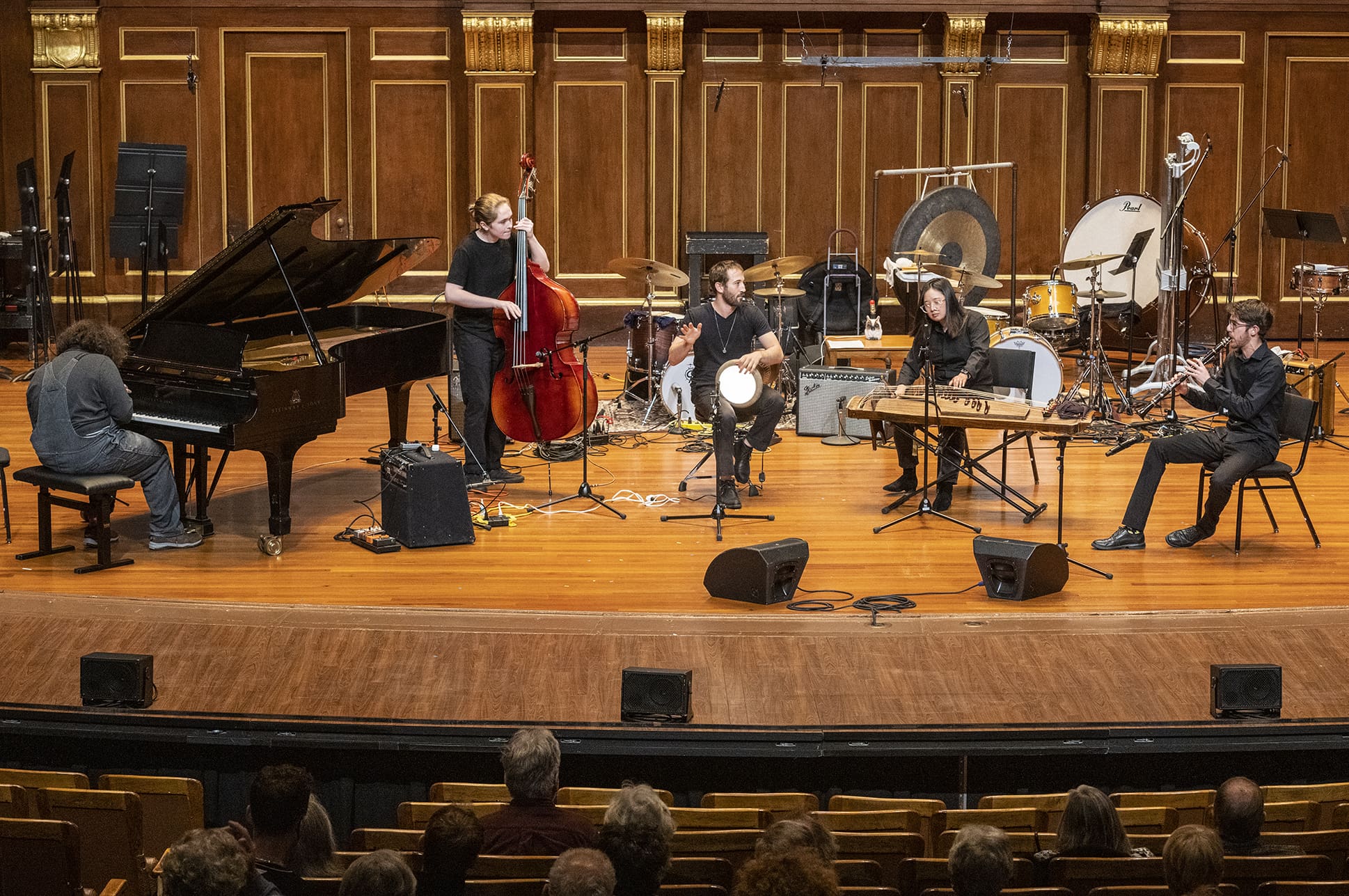
The Contemporary Musical Arts Department offers a variety of ensembles open to all NEC students by audition and on a space-available basis.
The expansive repertoire performed by these ensembles explores composition and improvisation through American and world music traditions ranging from classical to punk. Ensemble offerings vary each year depending on the specific composition of the department. Non-majors should sign up to audition during orientation.
CMA Ensembles
Endless Opportunities
From Afro-Cuban to Indian classical traditions, NEC students can immerse themselves in a rich tapestry of musical styles through CMA ensembles, fostering a truly global perspective on improvisation and performance.
Explore the Ensembles
Led by Eden MacAdam-Somer, this group provides an introduction to some of the many styles, genres, and regions that contribute to the music traditions of the United States. Past projects have included old-time fiddling, balladry, jug band music, honky tonk, early blues, music of the Georgia Sea Islands, percussive dance traditions, early country, spirituals, Cajun music, and more.
Led by Amir Milstein, this ensemble offers the chance to explore Chorinho, often regarded as the “Cultural DNA” of Brazilian music. It contains elements from different cultures and musical traditions which have influenced Brazilian music over the centuries. African rhythms, Eastern European dances, and Western Classical music forms have evolved into a virtuosic yet lyrical music style, played throughout the Cafes of Rio de Janeiro in the late 19th century to today’s concert halls and jazz festivals worldwide. There will be two sections of this ensemble meeting on Monday evenings; students will be assigned to one.
Led by Eden MacAdam-Somer, this interdepartmental ensemble explores the boundaries between composition, improvisation, and international music traditions through written and aural paths. Past projects have included engaging with works by Ruth Crawford Seeger, Ran Blake, Charles Ives, Gustav Mahler, Pauline Oliveros, Scott Joplin, Bach, and Lully, as well as traditional folk music, workshopping student compositions/concepts, and performing new works by students, faculty, and other contemporary artists.
Led by Erin Hogan, this is a vocal ensemble that will study and perform a variety of polyphonic traditions from around the world. Repertoire spans the vocal music of Bulgaria, Georgia, Scotland, Ireland, England, Africa, and the Americas, alongside works by contemporary composers such as Caroline Shaw, Meredith Monk, and Pauline Oliveros, among others. Student arrangements are welcome. Together, we will examine and celebrate the unique and vast capabilities of the human voice.
Led by Anthony Coleman, the Early Jazz Ensemble explores the vocabulary that formed the basis for music that has been the backbone of so much of American and world culture over the last hundred years and yet is relatively little understood. The Ensemble particularly focuses on rhythm and gestural concepts that were prevalent between the late teens and mid-1930s. The idea of the collective ensemble is key. Specific to the CMA version of this group, Coleman focuses to some degree on what has been called the “Avant-garde” of early jazz.
Led by Lautaro Mantilla, this ensemble is an introduction to the diverse repertoire of underground music of the 1970s and 1980s. This music was created in opposition to mainstream culture and often contributed as a medium to bring about a radical awareness of any form of discrimination and used as a platform for political and social protest. By arranging and recomposing music from Dead Kennedys, Frank Zappa, Black Flag, and The flat duo Jets, among many others, students gain knowledge of different compositional and improvisational approaches and explore what Bertolt Brecht may or may not have been loosely quoted as saying, “Art is not a mirror to reflect the world, but a hammer with which to shape it.” This fall, the ensemble will focus on music for the 1923 department production.
Led by Linda Chase, this ensemble explores the connections and relationships between music, improvisation, and other forms of artistic expression, including composition, poetry, visual art, and dance. A diverse repertoire of musical models is utilized, along with techniques such as conduction, incorporation of spoken word, partially composed improvisation, sound painting, and story-based pieces, serving as springboards for improvisation. The ensemble also explores relationships in music, nature, and transformation.
Led by renowned Irish fiddler Liz Knowles, this ensemble allows students to learn tunes from the tradition and explore stylistic nuances, improvisation, and arrangement ideas.
Led by Hankus Netsky, this ensemble offers students an opportunity to perform and arrange repertoire from a variety of Jewish traditions, including Klezmer, Cantorial, Middle Eastern, Hassidic, Yiddish Theatre, and folksong.
Led by Joe Morris, This ensemble explores the methodologies of Harmolodics, Unit Structures, Tri-Axiom Theory, and European Free Improvisation. Works by Cecil Taylor, Anthony Braxton, Ornette Coleman, Eric Dolphy, and Albert Ayler are studied alongside the music of Derek Bailey, Evan Parker, Barry Guy, and others. Graphic scores and conduction techniques are employed to develop skills and foster individual creativity within an open-form music context, using specific methods and materials.
Led by Balla Kouyaté, Mandé Music Ensemble is an introduction to West African history and culture through the music. There will be two sections of this ensemble, each rehearsing a separate night.
Led by Mal Barsamian, this ensemble explores a variety of Middle Eastern traditions.
This ensemble explores the wonderful and terrifying space between composition and improvisation, including original compositions by ensemble members and its director, along with pieces by such diverse masters as John Zorn, Christian Wolff, and Karlheinz Stockhausen.
In some semesters, this ensemble focuses on preparing performance versions of John Zorn’s classic composition, COBRA. Often called a “game piece,” it is a composition, a framework for performance, and a set of rules that organize a group of musicians into a community of sound. Rather than a conductor, COBRA is led by a “prompter” who facilitates communication within the ensemble, requiring both intense focus and adherence to the rules as well as a high degree of freedom and choice given to all members of the group.
Led by Nima Janmohammadi, this ensemble offers an introduction to Persian Music traditions.
Led by Joseph Copeland, this ensemble will study the secular and popular songs, and history of multi-regional and generational African-American music, born of the Blues, jazz, and religious music, known for its strong rhythmic feel/groove under improvised and melismatic melodies.
Repertoire will feature songs from the 1940’s to its current form, contemporary R&B, from such legendary artists as Lois Jordan and his Tympany Five, Little Richard, Ray Charles, Aretha Franklin, James Brown, Whitney Houston, Luther Vandross, Jill Scott, D’Angelo, Musiq Soulchild, Erykah Badu, and many more.
Led by Steve Netsky, this ensemble offers a framework for songwriters to work on creating original songs drawing on a variety of contemporary genres. You do not need to have written songs before, but you should have some experience playing and singing songs by others.
Led by Ted Reichman, this experimental ensemble will explore live performance with electronics including laptops, synthesizers, tablets, pedals, and as many other devices as possible. Students will develop a performance methodology incorporating ideas from a wide range of electronic styles, potentially including (but not limited to) ambient music, noise, dance music, hip-hop, and electroacoustic composition. Students will be expected to bring their own equipment — but that could be as simple as a smartphone or a tablet. Please note: this is an improvising ensemble, not a rock band or a songwriting/production workshop. Collaboration and technical exploration will be emphasized.
Led by Akram Haddad, this ensemble provides an introduction to repertoire from many international musical traditions, with a focus on aural learning, developing a solid groove, working out ensemble arrangements, and learning how to accompany and solo in different styles.