

 Performances + Events
EE Faculty Recital: Jessica Lizak, Flute
Pierce Hall
Artist(s)
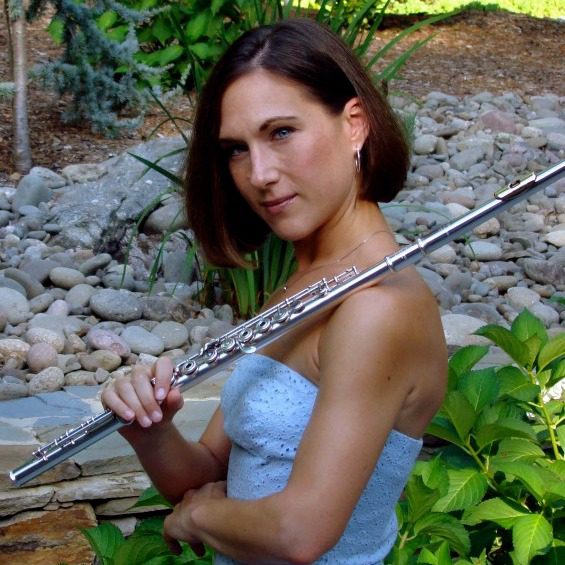
Jessica Lizak
Flute
Flutist Dr. Jessica Lizak enjoys a professional life actively engaged within Boston's versatile and inspiring music scene. With a style described as "poised, gorgeous, musical, and very sweet", she eagerly embraces music from all periods and genres. The Boston Music Intelligencer has described her performances as full of "youthful energy and rhythmic drive," as well as possessing "light and free precision...a nearly jazz-like casualness."
Jessica actively performs with many of New England's leading musical ensembles, including the Vista Philharmonic, Boston Modern Orchestra Project, Odyssey Opera, Marsh Chapel Collegium, Opera North Orchestra, and the Orchestra of the Back Bay Chorale. She has also performed with the Boston Pops Orchestra, Portland Symphony, Boston Philharmonic, Boston Ballet Orchestra, Rhode Island Philharmonic, Masterworks Chorale, Pro Arte Chamber Orchestra, Sound Icon, Albany Symphony, Springfield Symphony, and Symphony New Hampshire, among others. She has been selected to perform as a Fellow at the Tanglewood Music Center (MA), Music Academy of the West (CA), Domaine Forget (Canada), and Interlochen (MI). She was awarded top prizes in several competitions, including the Pappoutsakis Flute Competition, Myrna Brown International Flute Competition, Bohemians Club of the Detroit Symphony Concerto Competition, and was a multiple winner of the Boston University Departmental Award for outstanding musical achievements. She has been a soloist and lecturer at the National Flute Association's Conventions and Boston Flute Fairs, and she has performed as a chamber musician on WGBH, WCRB, and WBUR.
Jessica has appeared in concert across the United States, Canada, and Israel, and her orchestral solos have been heard in the great halls such as Carnegie, Jordan, and Symphony Hall. In 2008, she was invited as a guest artist to perform at Tanglewood, specifically for the monumental Festival of Contemporary Music dedicated to the works of Elliott Carter. Her discography includes three commercial recordings available through the BSO website: a live performance of the American premiere of Carter's opera What Next? conducted by James Levine, the first BSO release of live performances of the Tanglewood Music Center Orchestra, and a musical memento of Tanglewood's 2008 100th-birthday celebration of composer Elliott Carter. She regularly records with the Boston Modern Orchestra Project (BMOP), Boston’s premier orchestra for newly composed and experimental orchestral works. In addition, she has recorded with recording artists Natalie Merchant, Tim Janis, and John Lithgow. She can also be heard on chamber music recordings through Parma/Navona Records, including "Goddesses" and "Polarities".
Equally committed to education, Jessica maintains vibrant private studios and is the proud teacher/mentor to the top young flutists in Boston. Her students regularly place top rank in competitions and hold seats in all of Boston's premier youth orchestras and bands. She has completed the highest degrees in music performance, which also includes a Concentration in Music Education from NEC. She teaches in association with the New England Conservatory Preparatory School, Walnut Hill School for the Arts, Lexington Fine Arts Department, and Winchester Music School, and has been on the artist faculty with the Boston Youth Symphony. In the summers, she is on the artist faculty for Floot Fire Boston Flute Intensive.
Jessica earned her BM from the University of Michigan, MM from the New England Conservatory of Music, and DMA from Boston University. She owes her life in music to her inspirational teachers, including Nina Barwell, Leone Buyse, Geralyn Coticone, Marianne Gedigian, Renee Krimsier, Elizabeth Ostling, Fenwick Smith, and Jeff Zook.
Kanako Nishikawa
Piano
Ms. Nishikawa received her Bachelor of Music degree in Piano Performance from Toho-gakuen School of Music in Tokyo, and continued her studies at the New England Conservatory of Music where she received her Master of Music degree with Honors. Ms. Nishikawa received an Artist Diploma with Honors in both Piano Performance and Chamber Music at Longy School of Music where she performed as a soloist with the Longy Chamber Orchestra. Ms. Nishikawa is an active soloist, chamber musician and collaborative pianist throughout the United States, Europe, Israel and Asia. In recent years, she has been invited to perform in the Philippines Embassy in Washington, D.C., the Villa Primavera in Penang, Malaysia, the Jerusalem Music Center in Jerusalem and the Felicja Blumental Music Center in Tel Aviv, Israel. Currently she teaches at Wellesley College and Dana Hall School of Music in Wellesley.
Katherine Hoover (1937-2018)
To Greet the Sun
"To greet the sun is to give thanks for the great richness of the Earth and the gift of life. Various cultures have done this in differing ways, from dawn prayers to dances and ceremonies to researching the sun's awe-inspiring power." - Katherine Hoover
Deceptively difficult, To Greet the Sun is a mystical and spiritual work that captures the power, grace, and mystery of the sun.
Katherine Hoover was an American composer of contemporary classical music and chamber music, flutist, composition and theory educator, poet, and conductor. Her career as a composer began in the 1970s, when few women composers earned recognition in classical music. She composed pieces for solo flute, mixed ensembles, chamber orchestra, choir, full orchestra, and many other combinations of instruments and voice. Some of her flute pieces incorporate Native American themes. Her works have received many honors, including a National Endowment for the Arts Composer's Fellowship, an American Academy of Arts and Letters Award in composition, and the National Flute Association's Lifetime Achievement Award, where she is remembered by as an "artist, flutist, teacher, entrepreneur, poet, and, most notably, a distinguished composer.
Valerie Coleman (b. 1970)
Amazonia
“Amazonia is a commemoration poem of what is considered to be the “lungs of the earth”. The poem describes its natural beauty that progressively becomes destroyed, as the dark aspects of human nature intrude upon vitality. The work begins at Sunrise with the sounds of nocturnal animals like frogs and insects enjoying the last parts of the night, with the sounds of croaking and leaves moving erratically throughout the foliage. Tree frogs, Tamarin monkeys, and macaws sing their sounds, while drips of dew fall from the leaves, and provides a raindrop-esque motif throughout the first part of the work. The opening motif in the flute gives a fragmented taste of the grooves and rhythms found in Brazilian music.
As the Amazonia scene is set, a simple melody emerges representing the carefree children of the Amazon, who innocently play throughout the jungle and river, immune to the dangers that lurk around them. The melody itself is a sweet dance that turns to a more mature stance that describes the peaceful pride of the tribal adults. Theirs is an intentional way of life that is unimpeded by technology and urban landscape, greed and crime. Following a brief flute cadenza, the section ends with a still life Sunset of reds, oranges and yellows.
As the work unfolds, darker elements soon cloud the landscape, in a section called “Menacing”. The piano ominously marks the entrance of poachers and mercenaries into the rainforest, with an aggressive yet stealthy march. Their job is to drive out the tribes from the forest through intimidation and assault. Here the flute becomes the aggressor as its lower register articulates the word, fire in Morse code, as an impending signal to the burnings that will soon occur. Elements of Samba emerge within the following più mosso section, with the piano part dancing a macabre dance that symbolizes greed, as corporate interests circle the forest like vultures about to feast on the defenseless. Shouts, run, and anger precede the start of fire trickling through the rainforest, signified by a single note shared between the flute and piano that chromatically undulates and becomes more intense as the fires build and consume. Amazonia ends on an intense panic of shrieks and screams.
As the fires in the Amazon rainforest have decimated thousands of acres, we must remember the beauty of what once was. -Valerie Coleman
Yuko Uebayshi (b. 1958)
Le Moment du Cristal (2012)
“Le Moment du Cristal” for flute and piano is dedicated to 22-year-old Seiya.
“I met Seiya when I listened to his performance at Rampal concours in 2008 at Paris. A song full of romance that he played spoke strongly to my heart and It never disappeared and kept shining. But I never imagined that four years later, the day would come when I would write a piece with his music.
After that I had the opportunity to listen to his music several times. His music is always Seiya himself and it never came from other sources. What a fresh sensibility! Everything is lively and sparkling. The sorrow and also joy of his expression are so beautiful! And every time when I listen to his performance, his music is changing.
One day suddenly a lightning bolt fell from heaven. One year later, Seiya's music will already be different. I want to write down music for Seiya now! I wanted to get closer to his youthful sensibility by writing a piece with his music. Whether my music could resonate with his sensibility, this work was also a challenge for me.
I started to compose in mid-July and almost finished it at the end of August. I think I've put my soul into all parts of this piece that I've become empty.…. I think I've kept my soul in every corner of this work so much that I'm empty. 22-year-old Seiya is in "Crystal Time” now.
“Le Moment du Cristal” is composed of three parts. I wanted to compose the music with young passion, fragility, dynamism, and loneliness. And I also wanted to always give shine in the music. When I composed ``Le Moment du Cristal’’, Seiya actually had one request. "I always feel lonely after a concert ends. I want to play a music that makes me want to play at that time."
After the sun sets, the western sky is instantly dyed in a soft pink color. The tranquility at the end of the day intersects with the desire to regenerate tomorrow. I hope you can feel love and certain hope for tomorrow at the end of this piece.
Now, after many years, I think. We want our lives to always be a Le Moment du Cristal;
“Le Moment de Cristal” of each person living now. I think that “Le Moment du Cristal” is a piece that expresses “landscape” and “thoughts” as one. We should be able to listen to the scenery imagined by each performer and their sparkle, their melancholy, their kindness, their passion, their hope, their love, their prayers...their various thoughts will reach to people’s heart through their music.” -Yuko Uebayashi
Daniel Dorff (b. 1956)
Three Lakes Sonata
Continuing a series of nature-inspired flute music full of lyricism and transcendent beauty, Daniel Dorff has created a sonata depicting three lakes that bear poignant memories.
“Lake Wallenpaupack” is a dramatically beautiful oasis in the middle of the woods in Pennsylvania's Pocono Mountain resort area. It looks like the glacial lakes of Maine even though it's actually manmade. This movement recalls a romantic getaway vacation on Wallenpaupack, and the music blends the free-floating flow of a gentle lake current with a lyrical love song, never quite leaving the feel of the hanging trees hiding the lake’s mysteries.
“Kezar Lake” is in southwestern Maine; it hosts many summer cabins including a resort named Quisisana that hires young professional musicians to serve as the staff by day and entertainment at night. My parents vacationed there for over 20 years, and their ashes will live on together in Kezar for eternity. The movement is a memorial to my father who became part of Kezar Lake while the sonata was being composed.
“Salmon Lake” is an exuberant scherzo following the moderate and gentle first two movements. Home to Whisperwood Lodge & Cabins in central Maine, my childhood summers included vacations there, and this movement is a recollection of my frisky 8-year-old self. Salmon Lake remains a mystical memory in a deep way, and a symbol of childhood playfulness. -Daniel Dorff
Amanda Harberg (b. 1973)
Court Dances (2017)
In Court Dances, Amanda Harberg’s palette sparkles with her trademark sense of magic, delight and warmth. Initially inspired by the fast and syncopated bounce of a squash ball, Court Dances grew into a celebratory and soulful suite in three virtuosic movements. Court Dances was co-commissioned by 57 flutists from around the world in a consortium that was spear-headed by flutist Cobus du Toit. It was premiered at the National Flute Association convention in Minneapolis in August, 2017 by Mr. du Toit, with the composer at the piano.
Blending old and new, each movement of Court Dances references courtly dances and songs of the 16th and 17th centuries. The first movement, Courante, reflects the lively character and triple meter typical of its Baroque namesake. Playful yet driving, Harberg's writing reflects harmonic depth and demands from the performer rhythmic precision and close attention to changing articulation patterns.
The lyrical and flowing second movement, Air de Cour, offers an introspective contrast to the more gregarious first and final movements. The dynamic final movement, Tambourin, opens with running 16ths exchanged between the flute and piano. Accents, syncopation, and sparkling runs, as well as percussive effects and flutter tonguing, further develop the excitement alluded to in the opening.