
 Performances + Events
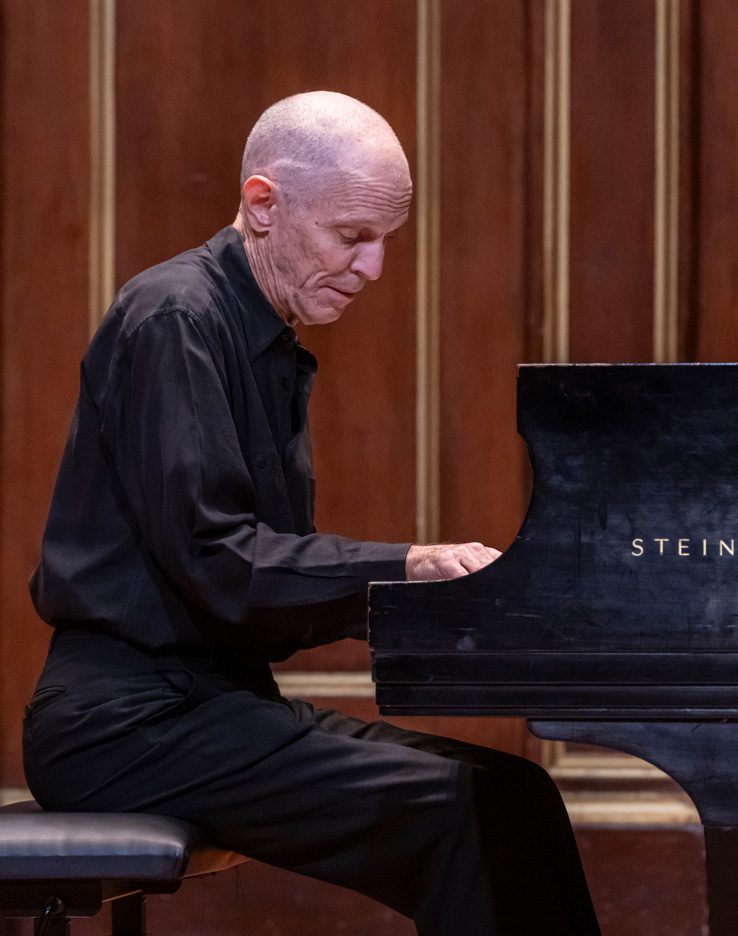
Stephen Drury
Education and Training
AB, Harvard College; AD, New England Conservatory. Studied piano with Claudio Arrau, Patricia Zander, Margaret Ott, William Masselos, Theodore Lettvin
Awards and Recognition
Concert Artists Guild Award
Affiliate Artists Award
Prize winner, Carnegie Hall/Rockefeller competitions
The U.S. State Department sponsored two concert tours that enabled him to take the sounds of dissonance to Paris, Hong Kong, Greenland, Pakistan, Prague, and Japan. He has appeared as conductor and pianist at the Angelica Festival in Italy, the MusikTriennale Köln in Germany, the Spoleto Festival USA, the Britten Sinfonia in England, as well as at Tonic, Roulette, and the Knitting Factory in New York. Drury has also performed with Merce Cunningham and Mikhail Barishnikov in the Lincoln Center Festival, at Alice Tully Hall as part of the Great Day in New York Festival, with the Boston Symphony Chamber Players, and with the Seattle Chamber Players in Seattle and Moscow.
A champion of 20th-century music, Drury’s critically acclaimed performances range from the piano sonatas of Charles Ives to works by John Cage and György Ligeti. He premiered the solo part of John Cage’s 101 with the BSO and gave the first performance of John Zorn’s concerto for piano and orchestra Aporias with Dennis Russell Davies and the Cologne Radio Symphony. He has commissioned new works from Cage, Zorn, Terry Riley, Lee Hyla, and Chinary Ung.
Drury has given masterclasses at the Moscow Tchaikovsky Conservatory, Oberlin Conservatory, Mannes Beethoven Insitute and throughout the world, and served on juries for the Concert Artist Guild and Orléans Concours International de Piano XXème Siècle Competitions.
His recordings include music by Beethoven, Liszt, Stockhausen, Ravel, Stravinsky, Charles Ives, Elliott Carter, Frederic Rzewski, John Cage, Colin McPhee, and John Zorn. Drury created and directs NEC’s Summer Institute for Contemporary Piano Performance, and assumed directorship of NEC’s Enchanted Circle concert series in 1997.
Recordings on Tzadik, Mode, New Albion, MusicMasters, Catalyst, Avant, Neuma, Carlton Classics.
Curriculum Vitae
AB, Harvard College; AD, New England Conservatory. Studied piano with Claudio Arrau, Patricia Zander, Margaret Ott, William Masselos, Theodore Lettvin
- Concert Artists Guild Award
- Affiliate Artists Award
- Prize winner, Carnegie Hall/Rockefeller competitions
June 17 / 5:43 PM
NEC Wind Ensemble and Symphonic Winds + Kevin Holzman, William Drury
Affiliated Departments and Programs
Piano