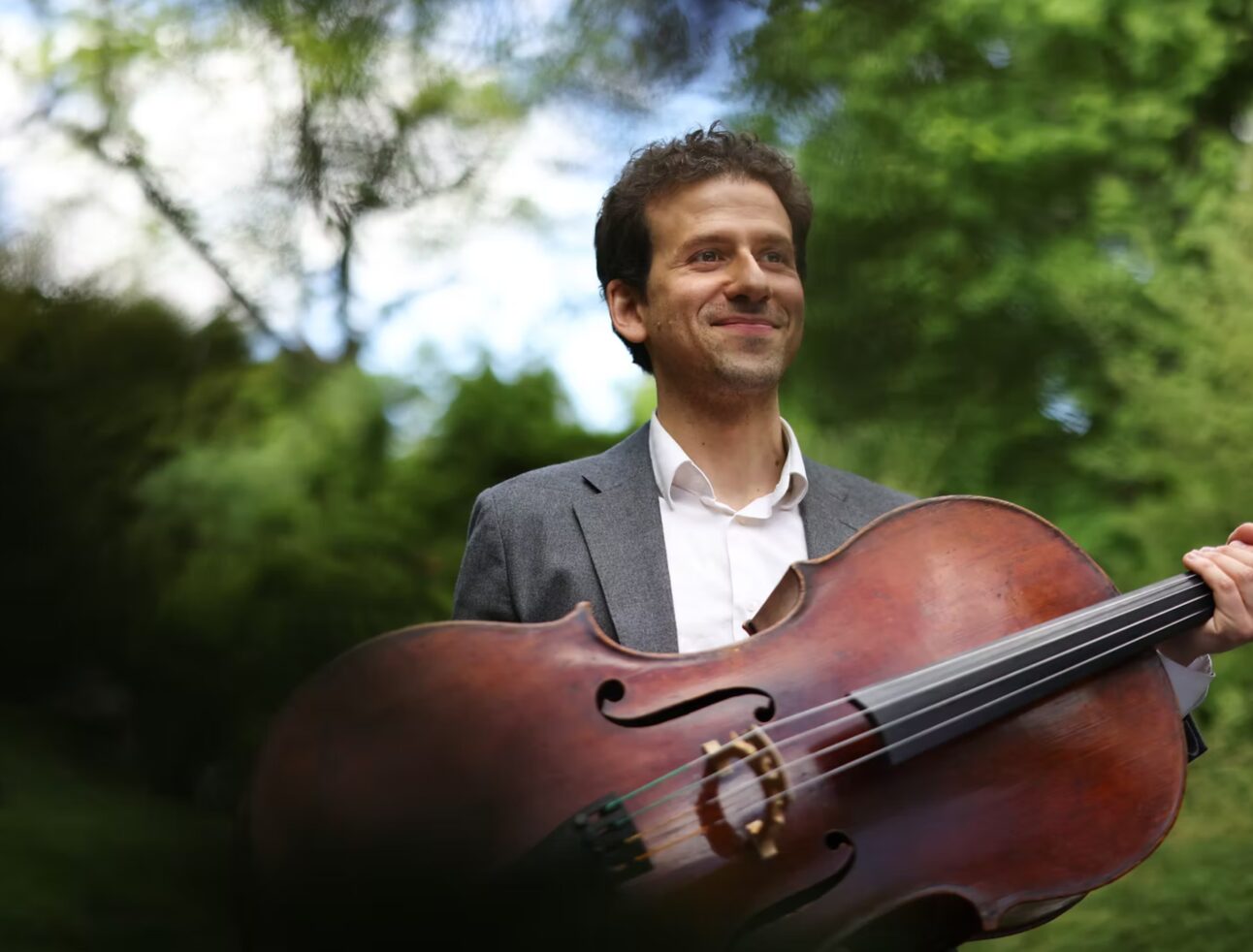
In late March, oboist and New England Conservatory alumnus Kip Zimmerman ’22 MM won a job in the Boston Symphony Orchestra and, in September, will begin serving as the ensemble’s associate principal oboist (and as principal oboist of the Boston Pops), succeeding NEC faculty member Keisuke Wakao, who’ll retire as the BSO’s assistant principal oboist at the end of the Tanglewood season.
It had been six-and-a-half years since Zimmerman had reached the finals of the Philadelphia Orchestra’s principal oboe audition. In the interim, Zimmerman earned his Master of Music degree from NEC, where he studied with the BSO’s principal oboist, John Ferrillo. We spoke with Zimmerman, who holds an undergraduate degree from the Curtis Institute and an Artist Diploma from Oberlin, about his time at NEC, audition preparation, challenges he’s faced as a performer, and more.
Q: How did studying with John Ferrillo at NEC prepare you to audition for and ultimately work in the Boston Symphony Orchestra?
A: My lessons with John Ferrillo were completely invaluable, even though they took a few years for me to digest. I came to NEC basically aiming in the same aesthetic direction as Mr. Ferrillo, but lacking a few of the fundamental elements to realize that aim. Our time together was spent trying to fill those gaps, which was simultaneously top-down and bottom-up work. We always held in mind the artistic goal — namely the freedom to play beautiful phrases on the line of the wind with fluency and with stable pitch — and worked backward to more clearly define what that meant and what the necessary components were for achieving it. We spent a lot of time in technical discussion of the equipment and the various ways it could enable or interfere with the oboist’s ability to make music. It’s really crucial to approach the oboe in a holistic way like this, and that’s where Mr. Ferrillo excels.
Q: What overarching lessons from your time at NEC do you carry with you today, onstage and off?
A: Beyond my oboe-specific studies it’s hard to be concise with this. I do have a number of very meaningful friendships from my NEC days that have endured, friendships that caused me to spend a lot of time immersed in other genres of music and the peculiar cultures around them. Boston is a really rich city for this, and NEC also makes a point of being a conservatory for many, sometimes obscure, genres. I think it’s really important to branch out and not spend all of your time in one domain.
Q: How did the BSO’s performances inform your artistic development when you were a student at NEC?
A: The BSO has been a constant source of inspiration, well beyond my time at NEC. Their recordings with Andris Nelsons are really a north star for rich, blended sound and precision, with so much individual artistry to admire, too. Getting to hear them regularly in person, sometimes up close, gives one a sense of how that sound is being produced and how the acoustic of Symphony Hall influences their style.
Q: The BSO’s longtime assistant principal oboist, Keisuke Wakao, will retire at the end of the Tanglewood season. How does one prepare to introduce a new, unique sound to a section?
A: Keisuke and I come from the same oboistic tradition and set of influences, so I don’t think the difference will be particularly jarring. Of course, every musician has their own artistic personality and that is part of the beauty of orchestras. One can listen to recordings of the BSO over a span of a hundred-plus years and hear the steady evolution of the ensemble as a product of the individual voices. I’ll be actively listening to my colleagues and probably putting a recording device out in the hall occasionally to check my perception of balance.
Q: What did your preparation for the BSO audition look like? Would you take us through the process?
A: When the excerpt list was announced I got a hold of the sheet music as soon as I could and started practicing, learning any of the excerpts I was unfamiliar with first and apportioning as much time as needed to the difficult passages to make them secure. There was a lot of self-recording to make sure what was printed on the page was actually making it out into the audience. I played regularly for other people, in a variety of acoustics, trying to simulate the audition experience to the best of my ability. I strived to stockpile a surplus of reeds that could do the job in various weather conditions, since it is difficult to predict the climate at the time of the audition. I arrived in Boston a few days early to get comfortable, make a (reed) selection, and refine anything I needed to. I gave a lot of care to sleeping well and managing my energy levels throughout. I had some wonderful mentors and friends that were a major part of all of this.
Q: What mental and/or physical challenges have you faced related to performance and how have you overcome those?
A: The list is long … Probably the biggest challenge I faced was persisting over 10 years of auditioning without a single win, with results that often felt disconnected from the quality of performance I had given. In my undergrad I went from making finals in the Philadelphia Orchestra’s principal oboe audition to not advancing out of the first round in Utah a few months later, in spite of feeling like I had performed better in every way. In 2024–2025 I went back to school, revamped my preparation, felt great about it, and only advanced out of prelims in one of the four auditions I took. Auditions are cruel in this way, with so many factors out of your control and such a narrow window in which the judgement is made. It can be difficult to remain objective and impartial when your most valued metric is spitting out confusing results — after a time it becomes frighteningly easy to disbelieve in your abilities and worth, and even to become distrustful of the wonderful people encouraging you. For me, the solution was to be very disciplined about training myself to not identify with the “successes” or the “failures,” but with the quality of my practice and process of preparation. This meant a lot of faith in my mentors and the process of improvement itself.
I was also plagued by a pretty nasty adrenaline response during high-stakes performance, which developed early in college and I think was mostly a consequence of caring intensely about the result but feeling insufficient to influence it. After a while you become hyper aware of all the little things that can go wrong unexpectedly, and if you’re anticipating those and trying to control for them, that quickly drains your attentional resources and causes you to make an entirely new mistake, which you can then add to the list for next time! It’s a vicious cycle that makes you feel out of control of your body and mind. In the Boston audition I tried to think about myself as little as possible and just give everything to the music. It helped a lot!
Q: What are you currently reading, listening to, and watching?
A: Lots of videos and academic texts about acoustics, measurement techniques, and machining! I regret letting my math skills deteriorate in music school … There are just too many interesting things to learn and do in this world and it takes a long time to gain competence in something.
Read about the landmark BSO x NEC Alliance, which fuels innovation and excellence in orchestral music in Boston and beyond.