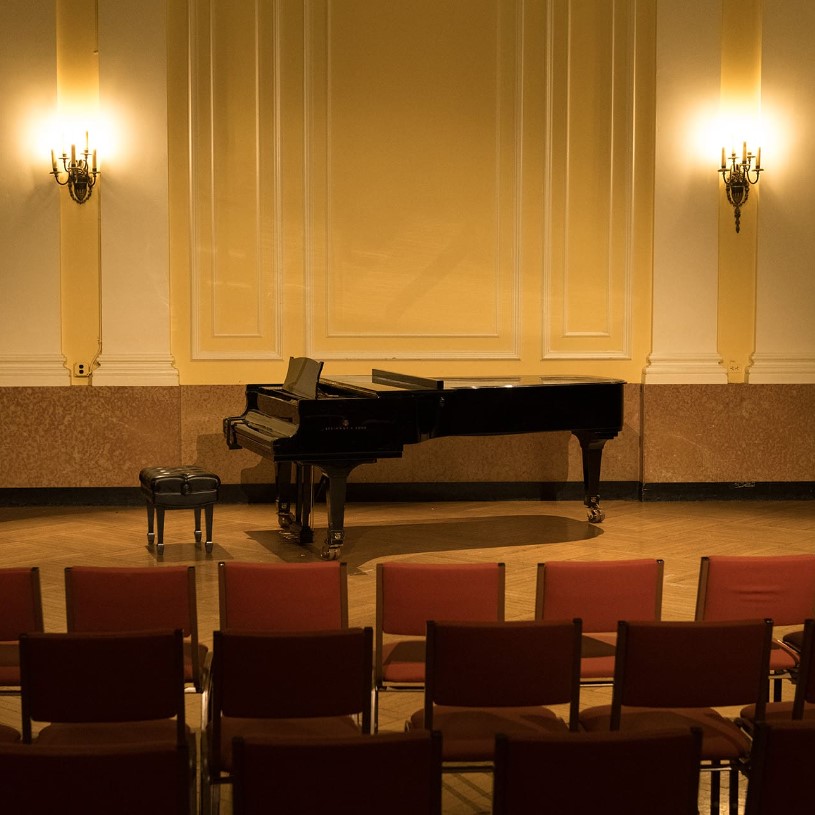
Tuesday Night New Music is a student-run, faculty-supervised concert series that offers the opportunity to hear music by the next generation of composers: current NEC composition students. The series is directed by Katherine Balch '14 Tufts/NEC and Neal Markowski '13, under the supervision of composition chair Michael Gandolfi.

The notes on these works were written by the respective composers.

Delong Wang To Sleepy Lotus
Nan Cai, soprano
Kyle Ruggles, flute
Delong Wang, piano

Ari Sussman Theme and Variations on a Jewish Children’s Song
Ari Sussman, piano

Theme and Variations on a Jewish Children’s Song was an idea of mine since my junior year of high school. This year, I finally decided to put my ideas on paper. The theme is based on a Jewish children’s song entitled "Bim Bam, Shabbat Shalom" which means “Bim Bam, a peaceful Sabbath.” There are eight variations, each unique in terms of virtuosity, speed, technique, meter, sound, etc. There are many rich, soulful, heavy, and sweet melodies throughout, keeping the variations distinct and varied. The theme is near and dear to me; as a young child, I sang this song in preschool, and it is still taught to young children today.

Jonas Tarm Spring to Fall: To a Young Child
Susanna Su, vocals
Yasmine Azaiez, violin
Yiyiing Chen, piano

This piece is inspired by Gerard Manley Hopkins’s poem Spring and Fall: to a Young Child. As I interpret it, the child “Margaret” (or Margret in the adapted lyrics) mourns for the dying leaves in fall. As time goes by, she finds that new ones grow back in spring and the trees live on. At the end she realizes that she actually mourns for herself: though she is a leaf in the spring, she knows she will die in the fall. This piece was originally written for Chinese pipa (instead of violin) and boy soprano: with the Chinese pipa I found that the folk sounds, colors, and textures create an atmosphere of spring and fall. This performance marks the premiere of the violin version arrangement.

In general, the piece has an A-B-C-B-A structure. Tonally, the piece tries to achieve one thing: resolve to F-sharp minor. In the beginning of the first section, we hear a melody in the voice in F-sharp minor, but it’s met with dissonance and chromaticism in the instrumental part: later it resolves to F minor into the B section. In the last A section, we meet the first F-sharp minor chord which brings a sense of reality: “It is the man,” meaning what happens to leaves, happens to mankind. After the first encounter, the F-sharp minor quickly diverges to a tense coda and conclusion. Another important feature I highlight is the word “Margret.” Every time the word “Margret” is sung, a particular chord in the piano follows. This mysterious and tense chord foreshadows Margret’s reality throughout the piece. At the end, this mysterious chord and the name Margret come to a climax and meet the conclusion. As the violin spells out Margret in solfege (Mi-A-Re-G-Re-Ti), the piece concludes in F-sharp minor.

Date: February 26, 2013 - 8:00:PM
Price: Free
Location: Pierce Hall


Are you an NEC faculty member or student who is giving a school concert? Submit your artist and repertoire information now!


WITHOUT CRAFTSMANSHIP, INSPIRATION IS A MERE REED SHAKEN IN THE WIND. JOHANNES BRAHMS