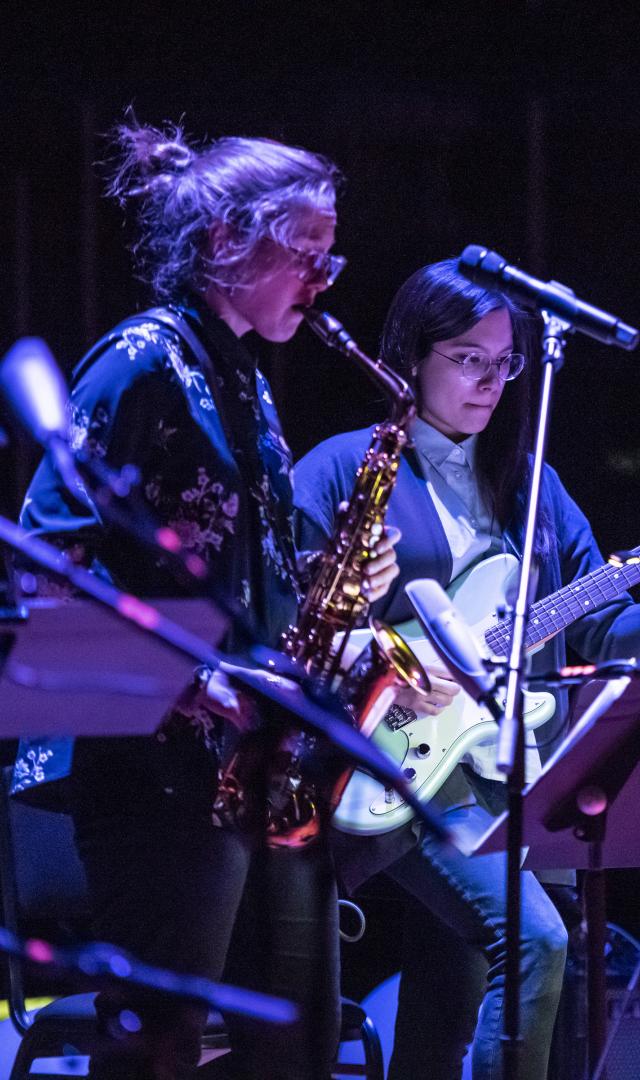
If you've been to a student recital before, you probably expect to hear something like a traditional concert by a touring artist.
Recitals by doctoral students are a somewhat different affair. In the course of completing the Doctor of Musical Arts degree at New England Conservatory, performance majors present not just one, but three full-length recitals, for which they also write program notes. Composers present a recital of their chamber music, then complete a large-scale original work. In both cases, it's an opportunity to observe multiple facets of an emerging artist.
Percussionist Jeremy Barnett is a Contemporary Improvisation major who studies with Bert Seager and Ted Reichman. For this D.M.A. recital he performs solo and is joined by fellow percussionists Maria Finkelmeier, Matt Sharrock, and Brian Calhoon.
Andrew Thomas Merlin
Improvisation with Maria Finkelmeier
David Friedman and Dave Samuels Carousel with Maria Finkelmeier
Jeremy Barnett The Grace of God
Steve Reich Electric Counterpoint
Jeremy Barnett Dreams of Progress with Brian Calhoon, Maria Finkelmeier, Matt Sharrock, Greg Simonds
Barnett has provided the following program notes.
Andrew Thomas writes of Merlin, "This work takes its inspiration from Edwin Arlington Robinson's ‘Merlin,’ a long narrative poem which evokes King Arthur's court and its progress into destruction. In the first movement, the knight Gawaine is looking towards the horizon, sensing the terrible events to come. The music is spectral and ambiguous. The second movement is concerned with time and the dissolution of order during time's passage. Here the perceived downbeat of the music constantly shifts, creating a flickering texture with no resting point." Merlin was commissioned by and is dedicated to William Moersch, who premiered the score at Merkin Concert Hall in New York City in March 1987.
Thomas has used two quotes from Robinson's poem to set the tone for the two movements:
1.
"GAWAINE, GAWAINE, what look ye for to see,
So far beyond the faint edge of the world?
D'ye look to see the lady Vivian,
Pursued by divers ominous vile demons
That have another king more fierce than ours?
Or think ye that if ye look far enough
And hard enough into the feathery west
Ye'll have a glimmer of the Grail itself?
And if ye look for neither Grail nor lady,
What look ye for to see, Gawaine, Gawaine?"2.
… Time's way with you and me
Is our way, in that we are out of Time
And out of tune with Time—Edward Arlington Robinson
Award-winning mallet players David Friedman and Dave Samuels have performed together as the duo "Double Image" since 1974. Separately they have worked with artists including Spyra Gyra, Frank Zappa, Pat Metheney, Wayne Shorter, Bobby McFerrin to name a few, and together have performed across the world, released multiple recordings and been nominated for a German Grammy award. Their music ranges from jazz standards and original compositions to through-composed pieces and spontaneous improvisations. Carousel is no exception with its tightly composed patterns and grooves separated by improvised solo sections.
The Grace of God is a composed improvisation that meditates on the nature of fate and luck. I am constantly amazed at how lucky I am, just to be here, right now. How it was decided that I am allowed to be free, healthy and pursue my dreams is something I am constantly amazed by and eternally grateful for. These things can never be taken for granted as there are so many who are dealt a hand worse than mine.
Electric Counterpoint is one of three of Steve Reich's Counterpoint pieces, all scored for a solo instrument along with a pre-recorded accompaniment of itself. Composed for famed jazz guitarist Pat Metheney and originally scored for electric guitar, the work is in three movements (fast-slow-fast) performed without a break. Many of Reich's usual compositional techniques are explored—canon, additive rhythms, composite melodies—all underlined by some of Reich's more funky ostinatos. The piece has enjoyed some subsequent fame as a source for DJ samples, with electronic artists including The Orb and RJD2 making use of the original Pat Metheny recording in their own music.
The title Dreams of Progress comes from an exhibition at the National Portrait Gallery in London focusing on Britain in the 1970s and 1980s. Describing the worsening conditions for the British working class during that time, a poster noted that the "dreams of progress" enjoyed by many had begun to slip away. This phrase stuck in my mind and made me think. We all want to progress, to move forward, to be more than we are right now—but how do we do that? Some see the answer lying in material wealth, possessions and success, defining themselves by how much they have made, what they own and how much better they are doing than others. But what of progress on the inside? Might it not be more important to dream of moving forward as a person, becoming more advanced at understanding ourselves and refining what we truly need to be happy? The piece is in two large sections reflecting this "outer" and "inner" world, one leading to chaos and one leading to unity.
Are you an NEC faculty member or student who is giving a school concert? Submit your artist and repertoire information now!


LOUIS ARMSTRONG