He's more than a bunch of symphonies and songs. Even those are not what you think. And although the music stopped with his death in 1911—100 years later, his time is now. During four months of concerts, jam sessions, conversation, and film, free your mind about what Mahler really means.

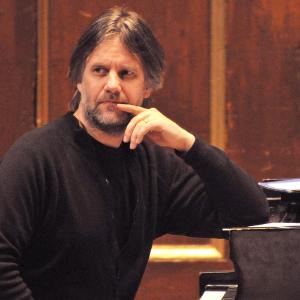
Since 1967, John Heiss has taught NEC students the roots of 20th-century modernism both in the classroom and as a conductor and coach. His courses on Ives, Schoenberg, and Stravinsky have shaped generations of musicians. Due to the accuracy of his ear in rehearsals, Stravinsky called him "the pitch doctor."

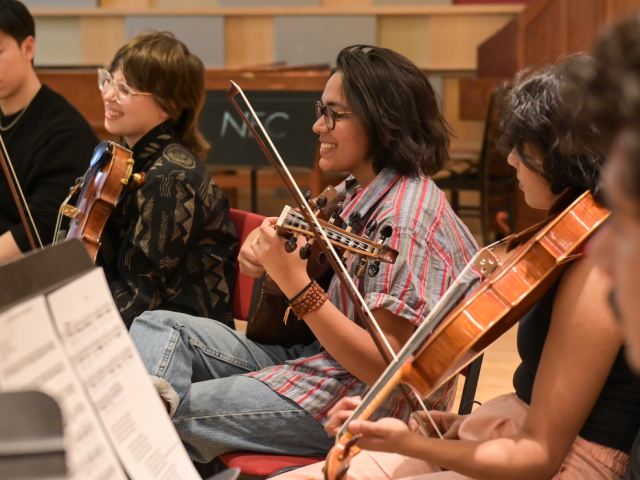
Each year Heiss recruits students interested in performing 20th- and 21st-century music to join the NEC Contemporary Ensemble. This year, the group's season begins with a program of works by Mahler, his Viennese modernist contemporaries and successors, and more recent composers who have perpetuated Mahler's "aura."

Mahler Adagio for Piano Quartet and
Schnittke Piano Quartet
Gloria Chien, piano
Lucy Chapman, violin
Dimitri Murrath, viola
Paul Katz, cello

Schoenberg Six Short Piano Pieces,
Op. 19
performed by Christopher Lim
Heiss
Four Short Piano Pieces
performed by Bretton Brown
Balch
Four Studies for Solo Piano
performed by the composer

Berg Four Pieces for Clarinet and Piano, Op. 5
John Diodati, clarinet; Bretton Brown, piano
Webern
Five Movements for String Quartet, Op. 5
Futura Quartet: Audrey Wright and Jeffrey Dyrda, violin; Samuel Gold, viola; Andrew Larson, cello
Three Short Pieces for Cello and Piano, Op. 11
Emileigh Vandiver, cello; Chistopher Lim, piano
Kurtág Jelek
Emily Deans, viola

Any composer, if he is not deaf, has different layers and a certain hierarchy in his musical mind. However, not every composer can work with the lower layers of his musical world. Some composers, like Webern, prefer to turn these layers into something "sublime," to make them hidden and not obvious. … In Mahler's music these low or unterhaltung layers are open and obvious. Mahler, Shostakovich, Ives and Zimmermann put the outer musical world, all its musical periphery, into their music. And this is my way as well.
—Alfred Schnittke

Gustav Mahler's single movement from an uncompleted piano quartet was published by Sikorski in 1973, shortly after its initial discovery, giving chamber musicians an all-too-rare opportunity to incorporate Mahler into their programming. Cellist Paul Katz, as a member of the Cleveland Quartet, along with his current NEC faculty colleagues Donald Weilerstein and Martha Strongin Katz, performed the North American premiere in Carnegie Hall with Michael Tilson Thomas as pianist—as an addition to an orchestral concert conducted by MTT in which the Cleveland Quartet was already performing Morton Feldman's Concerto for Quartet and Orchestra.

The uncovered Mahler work also delighted composer Alfred Schnittke, who is often described as being in the Mahler "lineage." Schnittke used Mahler's fragment as material for the second movement of his 1988 Concerto Grosso No. 4/Symphony No. 5, and then in 1989 published (also with Sikorski) his own piano quartet, which explicitly quotes Mahler and has inevitably invited a paired performance like the one on tonight's concert, where the Schnittke work fills the function of Scherzo to Mahler's Adagio.

The three short suites for solo piano on this program take Mahler's aura forward in 50-year bursts. Arnold Schoenberg's Op. 19 was composed in 1911, the year of Mahler's death. Inspired by this example, John Heiss wrote his own suite in 1961, and student Katherine Balch has returned to the form in 2011.

Alban Berg and Anton Webern were among the inventors of a musical High Modernism that took courage from Mahler's experiments and whose aura continued to spread, embodied in later composers like Gyorgy Kurtág.

Read John Heiss's note on this concert, and find other Mahler program notes.

Date: November 15, 2011 - 8:00:PM
Price: Free
Location: NEC’s Jordan Hall

Share with a friend!


Are you an NEC faculty member or student who is giving a school concert? Submit your artist and repertoire information now!


IF YOU HAVE TO ASK WHAT JAZZ IS, YOU'LL NEVER KNOW. LOUIS ARMSTRONG