Greetings, Readers! It is difficult for me to fully wrap my brain around the fact that March 7...
Greetings, Readers!
It is difficult for me to fully wrap my brain around the fact that March 7 was almost a full month ago! So much has happened it such little time…
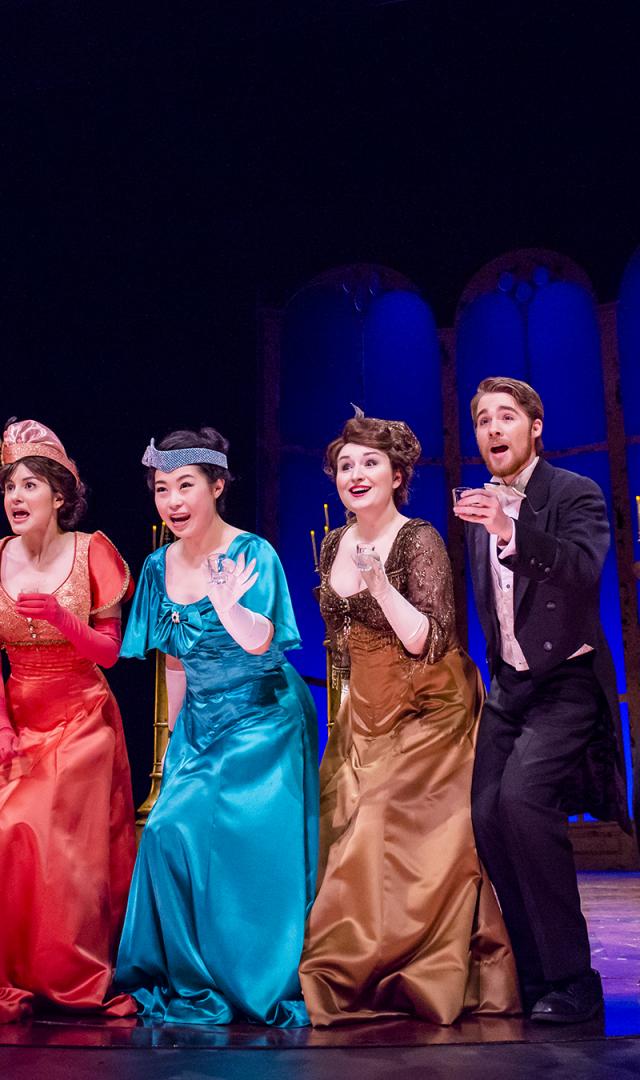
The NEC Concert Choir, in collaboration with the NEC Contemporary Improvisation Department, Hankus Netsky, the NEC Wind Ensemble, and soloists Adrienne Arditti, Erica Petrocelli, Julia Partyka, Joshua Quinn, led by Maestro Charles Peltz and narrated by President Tony Woodcock, presented a fantastic performance of Honegger’s King David at the Church of the Covenant in downtown Boston. Though Mother Nature attempted to weigh in and make a mess of the evening, she failed. Miserably! The performers had a lovely, appreciative audience, and they entertained them with the professionalism we faculty encourage them to embrace.
In fact, you can witness the performance yourself! Thanks to Andrew Hurlbut and members of the NEC Public Relations department, you can view the concert in its entirety. Click, turn up your volume, sit back, and enjoy!
No sooner had we successfully finished the Honegger King David Project the NEC Chamber Singers had three final tour preparation rehearsals, and we were at the Boston-Logan Airport by 5:00am on Friday, March 15 for our Mid-Atlantic Tour (see interior plane pic below!)!
I cannot say enough wonderful things about the level of professionalism, and humanism, these 28 students displayed over our 5 days together as we traveled from Boston, to Raleigh, to Greenville, to Washington, D.C., to Baltimore, and finally, home to Boston. Not only did the unspoken musical dialogue between each of them grow (in leaps and bounds!), but despite how tired they may have been, they performed each concert with a renewed spirit, magnificent sound and musical maturity well beyond their years. Think I’m biased in my opinion? I can’t blame you. Every conductor usually is! Take a listen to a few of the audio clips below. These were recorded during the March 17 afternoon performance at St. Peter’s Catholic Church on Capitol Hill in Washington, D.C. Not only do they sound glorious, they also performed, at the last minute, under the leadership of my second year graduate choral conducting student Darrel Whidden (I, unfortunately, became quite ill the night before – but as we performers always say, “The show must go on!”).
Robert H. Young – Sing Me A Song
Diane Loomer, arr. – Frobisher Bay
(Joseph Anthony Smith & Timothy Ayres-Kerr, tenors)
And so, here we are in April. I am convinced that as we age, Time insists on going faster! The Concert Choir is in week two of rehearsals preparing for our final performance this season; A Tribute to Tamara Brooks, Monday, April 29 at 8:00pm in Jordan Hall. We hope that if you will be in the Boston area you might join us that evening. The Chamber Singers will also perform on the program and will share the opening portion of their tour program. We’re considering it their official “home coming.” Though I never had the opportunity to meet Tamara, from what I have learned of her, I believe she would approve of the gesture.
Keep checking in on our blog. We’ll keep you posted with the comings and goings of the lives of the students involved in the NEC Choral Department. And of course, we hope to see you on April 29!
Best wishes,
Erica J. Washburn
Coming up: A Latin American Tour
The Simon Bolivar Orchestra of Venezuela.
At the invitation of El Sistema’s founder Dr. Jose Antonio Abreu, young Mexican conductor Jose Luis Hernandez-Estrada joins the Simon Bolivar Orchestra of Venezuela for their upcoming Latin American tour. Under the artistic leadership of Gustavo Dudamel, the tour takes the acclaimed orchestra to the principal concert halls of Buenos Aires, São Paulo, Brasilia, and Bogota. “I am honored to play a part in helping advance the ideals of El Sistema. This will be an inspiring tour and a wonderful opportunity to learn from Maestro Dudamel and his orchestra—a shining emblem of excellence, joy, and of the future of music,” Jose Luis said. For their April 1-12 tour, the orchestra performs a repertoire that includes Stravinsky’s Rite of Spring, Revuelta’s La Noche de los Mayas, and Beethoven’s epic Fifth Symphony.
Por invitación del maestro y fundador de El Sistema Dr. José Antonio Abreu, el joven director de orquesta mexicano José Luis Hernandez-Estrada se une a la proxima gira Latinoamericana de la Orquesta Simón Bolívar de Venezuela. Bajo el liderazgo artístico de Gustavo Dudamel, la gira llevará a la aclamada orquesta a las salas principales de Buenos Aires, São Paulo, Brasilia, y Bogota. “Es un honor el poder coadyuvar a impulsar los ideales de El Sistema. La gira sera una experiencia inspiradora y una gran oportunidad de compartir y aprender del Maestro Dudamel y su orquesta—hermoso emblema de excelencia, alegría, y del futuro de la música,” comento José Luis. Del 1 al 12 de Abril, la orquesta presenta un repertorio que incluye La Consagración de la Primavera de Stravinsky, La Noche de los Mayas de Revueltas, y la Quinta Sinfonía de Beethoven.
###
Roxbury Youth Orchestra's first day
YAMA launch
Changing Lives
Making new friends
The Ensemble, April edition
Virtue
NEC Sophomore’s thoughts about success
In my first blog on this subject I endeavored to set forth the career challenges and outlined the skills that a young musician should possess in these ever changing and highly technological times. That foundation in place, I could then “open the microphones” to a number of different voices in the form of guest bloggers invited to contribute to this series. My first writer is Lyle Davidson, the much respected and long time member of NEC’s Music Theory and Music in Education faculty. I have had many discussions with Lyle, which, due to our respective schedules, always seem to happen in the parking lot. Lyle is a great thinker, completely alive to all the energy and innovations of our age. He expresses a unique point of view and one that has helped to shape my own ideas. In this blog he has written something which in many ways I consider to be profound despite its simple narrative and clear conclusions. I love that he is obviously learning with the students as well as teaching.
Lyle Davidson with Solfege class
A brief word of explanation. Lyle mentions the “President’s Council for Entrepreneurship” which is a group of kindred spirits I convened from students, alums, faculty and outside organizations including the Boston Symphony, the Berlin Philharmonic, and the Royal Northern College of Music in the UK. We meet every year to discuss our progress in this field, to brainstorm new ideas and to challenge our thinking and direction. And I ADORE this group!!
–Tony Woodcock
NEC Sophomores discuss what contributes to success
Lyle Davidson
When I met with my Solfege 4 class on Wednesday, February 13, the students were expecting to sing through Beethoven’s Symphony no. 4 and conduct selected sections of the first movement. Our typical class activity includes exercises in six clefs, transposition, and score reading. They were ready.
But I decided to change the agenda. I wanted to share with them some of the thinking that took place two days earlier at the President’s Council for Entrepreneurship meeting. Rather than give them the headlines, I posed the question we had discussed: What training, skills, or experiences have been central to your personal success?
I told them how valuable the meeting had been. I described the variety of participants, pointing out that this was not simply a meeting of a single group, but included trustees, faculty, staff, and students. I described the question of success and the issue of the role of music and musicians in society today.
I asked them if they would like to consider the question of their own successes. They quietly looked at one another. I decided to push on with my agenda a little more. They continued to be a little puzzled until I pointed out that as musicians they were (and I looked at each student), indeed, successes.
“Maybe you don’t think of yourself as being successful. You are in an environment where everyone around you appears to be better than you are, where your teachers are constantly — as they should be — pushing you to do more. It is difficult under these circumstances to feel successful. But . . . (I paused for dramatic effect) . . . you have applied to one of the best music schools in the world, and you were accepted, and here you are, working with the people in the environment you set your sights on! Each one of you is a success!”
I then reframed the question to focus on what they felt had made their success possible. I waited a bit before calling on a student I knew would have a thoughtful response.
“A vision,” he said.
That did it. I went to the board and began writing what I heard: Vision. I put the first word on the board. If you don’t have an idea of what you really want to do, you will never succeed—at anything.
“Yes, but you have to have more than just an idea, you have to feel passionate about it,” said another student.
(I wrote Passion on the board).
“Yes, it has to be the most important thing in the world. It needs to inspire you,” someone else commented.
Inspiration went up. These students had a lot to say.
“Without passion and inspiration, you can’t really be as motivated as you have to be to be successful,” another added.
Motivation was the next word.
The class was off and running. Vision had to be fueled by passion, inspiration, powerful motivation.
I offered no suggestions; one student’s comments flowed into those of another. One student’s observation triggered another line of thought in a classmate. I tried to keep up. I always checked to see if what I was writing captured the essence of the meaning of what was being offered. I made sure that every student had the opportunity to contribute.
“Love. Love is very important,” one of the more reticent students said.
There was a giggle. Another student followed up by pointing out that love meant support and that without the support and sacrifice of friends and family it would be impossible to be here.
That brought the next response about the importance of money as a support. That brought lots of laughter.
“Money and scholarship assistance is just another form of the love and support necessary for a musician,” another student pointed out.
“What about a plan? You have to have a plan,” someone else added.
“Well, you have to be determined to carry it out. It takes a lot of persistence. If you don’t have the determination you may give up on your plan.”
“Opportunity is also important. You have to have opportunities.”
One person then pointed out that you have to be open to opportunity. “Opportunities may be all around you but if you are not open to them, then you don’t see them.”
Another student thoughtfully raised the issue of risk, pointing out that it is so easy to fail.
“You have to be ready to fail and not give up.”
Immediately another person spoke of the need for courage, while a third observed that a great deal of confidence was certainly necessary too.
“The teacher is really important. You have to have a good teacher. A good teacher supports you in all kinds of ways.”
“What about practice?” another student chimed in.
There was a lull in the flow. By now everyone had spoken at least once—even the more reserved ones.
Suddenly, one of the quieter students exclaimed, “I don’t think all these ideas have the same value. I think that some are more important than others.” (Oh, I do love these students.)
She argued that Vision was the most important thing. Almost immediately, another student pointed out the importance of the teacher.
“Without a teacher, you can’t achieve your vision by yourself.”
“But practice is important too. Without practice and lots of it, it didn’t matter what your vision or who your teacher was,” someone else chimed in.
The class time flew by. The board was full. I thanked the class and told them how much they had given me to think about. Some of the students copied down what was on the board. A couple whipped out their smart phones and took photos.
I realized that I too could take a picture.


WANDA LANDOWSKA